Asbestos insulation has no single look. In houses it turns up as a wrap, blanket, tape or coating on old heating pipes, boilers and furnace ducts, as board or paper around old stoves and furnaces, and as a contaminant in the pebble-like attic fill called vermiculite. You can’t confirm any of it by eye. EPA’s rule for homeowners is short: “If in doubt, treat the material as if it contains asbestos and leave it alone.” This page is part of our guides to old insulation and safety.
General information, not professional advice. Building codes are adopted locally, with changes, and your building department decides what applies to your house. Stop and call a qualified professional for anything this page marks as a stop.
Below: where asbestos was used as insulation, how the agencies describe it, how to tell the common attic materials apart without touching them, and what EPA says to do when the material is damaged or in the way of a job. There are no sampling, repair or removal steps on this page, and there won’t be: EPA says that work belongs to trained and accredited asbestos professionals.
Where asbestos insulation turns up in a house
Asbestos is a mineral fiber that occurs in rock and soil. Because of its fiber strength and heat resistance it was used in building materials “for insulation and as a fire retardant” (EPA, Learn About Asbestos, updated 13 July 2026). That history explains where it sits in a house: mostly around things that get hot, plus one kind of attic fill.
| Where | How the agencies describe it | Source |
|---|---|---|
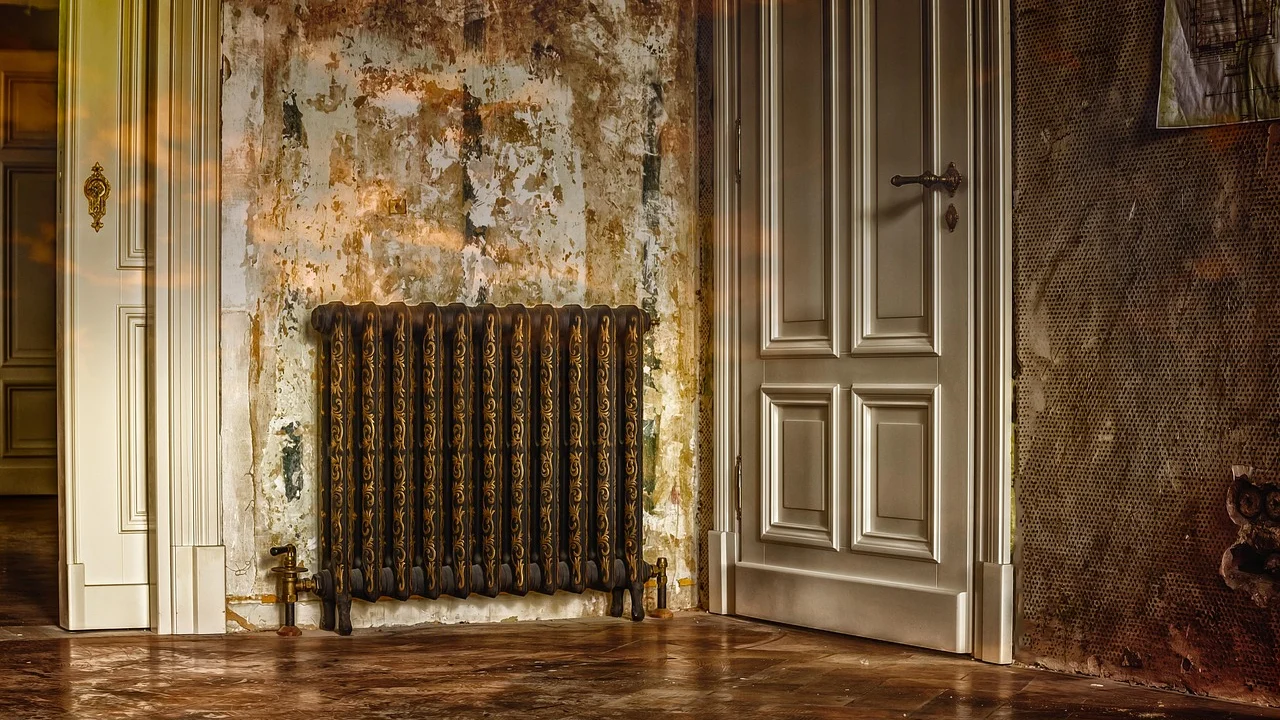
| Hot water and steam pipes | “coated with asbestos material or covered with an asbestos blanket or tape” | EPA, Learn About Asbestos |
| Boilers and furnace ducts | “insulated with an asbestos blanket or asbestos paper tape” | CPSC, Asbestos in the Home |
| Oil and coal furnaces and their door gaskets | “with asbestos insulation” | EPA, Learn About Asbestos |
| Walls and floors around wood-burning stoves | “protected with asbestos paper, millboard, or cement sheets” | EPA, Learn About Asbestos |
| Attics and walls | “Attic and wall insulation produced containing vermiculite” | EPA, Learn About Asbestos |
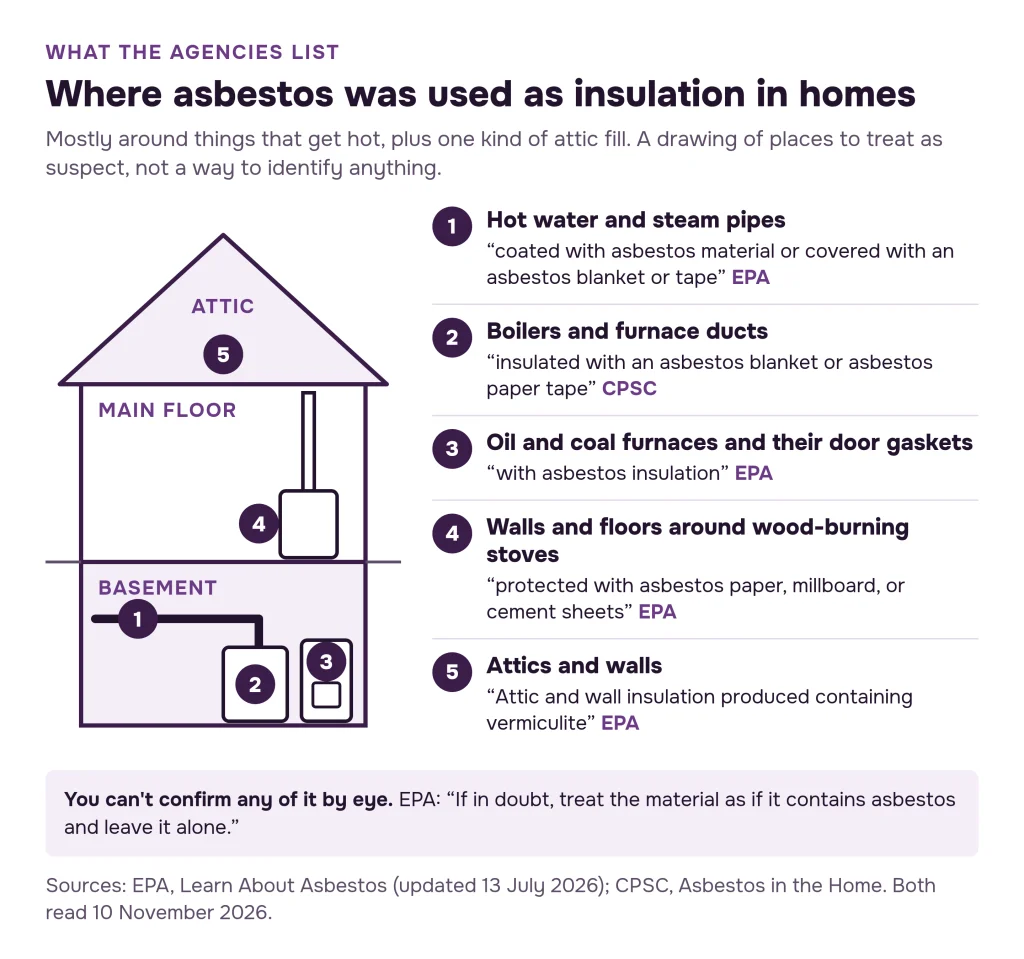
On age, the agencies give only rough guides. CPSC’s booklet Asbestos in the Home says “Houses built between 1930 and 1950 may have asbestos as insulation” and that “until the 1970s, many types of building products and insulation materials used in homes contained asbestos”. Neither line is a cut-off. A house built outside those years is not cleared by its age, as the section on bans explains.
What does asbestos insulation look like?
The honest answer comes first. EPA: “Generally, you can’t tell whether a material contains asbestos simply by looking at it, unless it is labeled.” CPSC goes further: asbestos “can be positively identified only with a special type of microscope.” So a description can tell you which materials to treat as suspect. It can never tell you a material is free of asbestos.
With that limit, this is what the primary sources describe:
- On pipes: a coating, a blanket or a tape around hot water and steam pipes (EPA). EPA’s own example photo is captioned “Asbestos pipe wrap (joint partially removed)”. CPSC adds that pipe insulation “was usually installed in preformed blocks”.
- On boilers and furnace ducts: a blanket or paper tape (CPSC).
- Around stoves and furnaces: paper, a stiff board called millboard, or cement sheets on the wall or floor, and the gasket around a furnace or stove door (EPA, CPSC).
- In the attic: vermiculite, “a pebble-like, pour-in product” that “is usually gray-brown or silver-gold in color” (EPA, vermiculite page, updated 17 April 2026). EPA describes the mineral as “shiny flakes, resembling mica”, in pieces from very fine to nearly an inch long. ENERGY STAR calls it “a lightweight, pea-size, flaky gray mineral”.
Notice what the agencies don’t give: a color, a texture or a test you can do with your eyes for pipe and boiler insulation. Other sites describe it as white or gray, chalky, or like corrugated cardboard. We found no agency description to check those against, and EPA’s point stands either way: looks don’t settle it. Location and age are the useful clues: an old covering on a heating pipe, a boiler, a furnace or a duct is suspect until an accredited professional says otherwise.
Cellulose, fiberglass, rock wool or vermiculite: telling attic insulation apart
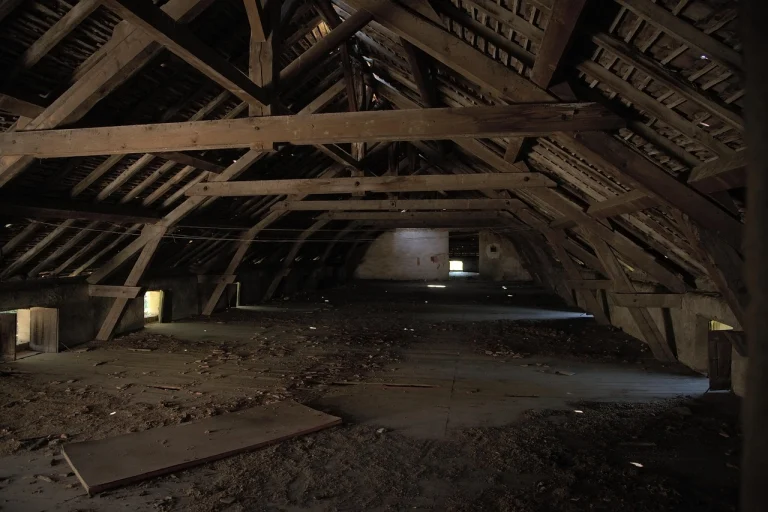
ENERGY STAR’s attic check has a short table for sorting attic insulation by sight, headed “What you see” and “What it probably is” (DIY checks and inspections, read 10 November 2026). Look from the hatch with a flashlight. Don’t dig, scoop or rub anything between your fingers to decide.
| What you see | What it probably is (ENERGY STAR) | What it’s made of |
|---|---|---|
| Loose fibers, “small gray flat pieces or fibers (from newsprint)” | Cellulose | Recycled paper, mainly newsprint, reduced to small pieces and fiberized, with borate added for fire and insect resistance (DOE) |
| Loose fibers or batts, “light-weight yellow, pink, or white” | Fiberglass | Molten glass spun or blown into extremely fine fibers (DOE) |
| Loose fibers, “dense gray or near white, may have black specs” | Rock wool | Mineral wool: rock wool from minerals like basalt, or slag wool from blast furnace slag (DOE) |
| Granules, “light-weight” | Vermiculite or perlite | Vermiculite: a mica-like mineral expanded by heat (EPA). Perlite: very small, lightweight pellets of popped rock (DOE) |
How to tell cellulose from asbestos
The mix-up is usually gray cellulose against gray vermiculite. The shapes differ. Cellulose is paper: small, flat, gray pieces and fibers made from newsprint. Vermiculite is mineral: loose pebbles or shiny flakes, gray-brown or silver-gold, poured between the joists (the framing boards of the attic floor). Fiberglass and rock wool are fibers too, never pebbles. More on the two common fibers is in our comparison of cellulose and fiberglass.
Three limits apply to any sorting by sight:
- “Probably” is ENERGY STAR’s own word. The table sorts insulation for estimating its R-value (its resistance to heat flow). It was not written as an asbestos check.
- Granules count as vermiculite. ENERGY STAR puts vermiculite and perlite in one row, and DOE says perlite is “commonly found as attic insulation in homes built before 1950”. If you can’t be sure which you have, follow the vermiculite rules.
- The top layer is only the top layer. Newer insulation can sit on top of older material. What you see from the hatch tells you nothing about what lies under it or inside the walls. EPA says it does “not recommend that you open your walls to check for vermiculite”.
If what you see is pebbly, stop there. EPA’s instruction, printed in capitals on its page, is that you “assume the vermiculite contains asbestos and do not disturb it”. Our page on vermiculite insulation and what EPA says to do covers the attic rules in full.
Why you leave it alone
Asbestos harms when its fibers get into the air and are breathed in. EPA says exposure to asbestos increases the risk of developing lung disease, that smoking makes that risk worse, and that symptoms may take many years to develop. Its vermiculite page adds: “There is no known safe level of asbestos exposure.”
Material that stays intact generally doesn’t put fibers in the air. From EPA’s homeowner page, Protect Your Family from Exposures to Asbestos (updated 25 June 2026):
Asbestos-containing materials that aren’t damaged or disturbed are not likely to pose a health risk. Usually the best thing is to leave asbestos-containing material alone if it is in good condition.
EPA, Protect Your Family from Exposures to Asbestos
The same page lists what does release fibers: material that is “disturbed, damaged, removed improperly, repaired, cut, torn, sanded, sawed, drilled or scraped”. That list is why a well-meant fix can do more harm than the insulation did sitting still. EPA says of sampling that, “if done incorrectly, sampling can be more hazardous than leaving the material alone”, and of removal that doing it improperly “may actually increase your and your family’s exposure to asbestos fibers”.
EPA repeated the point in November 2024, when it finished its risk evaluation of asbestos left in older buildings: “If asbestos is present in the insulation in an older building and the asbestos-containing insulation is not disturbed, the asbestos does not present a risk to those living or working in or near the building” (EPA Actions to Protect the Public from Exposure to Asbestos, updated 21 January 2026). The same evaluation found that disturbing and handling it does pose a risk.
EPA’s do’s and don’ts for homeowners
These are EPA’s lines for insulation and other suspect material, in its words:
- “Do leave undamaged asbestos-containing materials alone.”
- “Do keep activities to a minimum in any areas having damaged material that may contain asbestos, including limiting children’s access to any materials that may contain asbestos.”
- “Do take every precaution to avoid damaging asbestos-containing material.”
- “Do have removal and major repair done by people trained and qualified in handling asbestos. It is highly recommended that sampling and minor repair also be done by a trained and accredited asbestos professional.”
- “Don’t dust, sweep, or vacuum debris that may contain asbestos.”
- “Don’t saw, sand, scrape, or drill holes in asbestos-containing materials.”
- “Don’t track material that could contain asbestos through the house.”
EPA also asks you to keep an eye on suspect material without touching it: “Look for signs of wear or damage such as tears, abrasions, or water damage.” Material that gets hit, rubbed or handled often, or that is exposed to extreme vibration or air flow, is the kind to watch. A pipe covering at head height on the way to the laundry is one example.
When it’s damaged, or in the way of a job
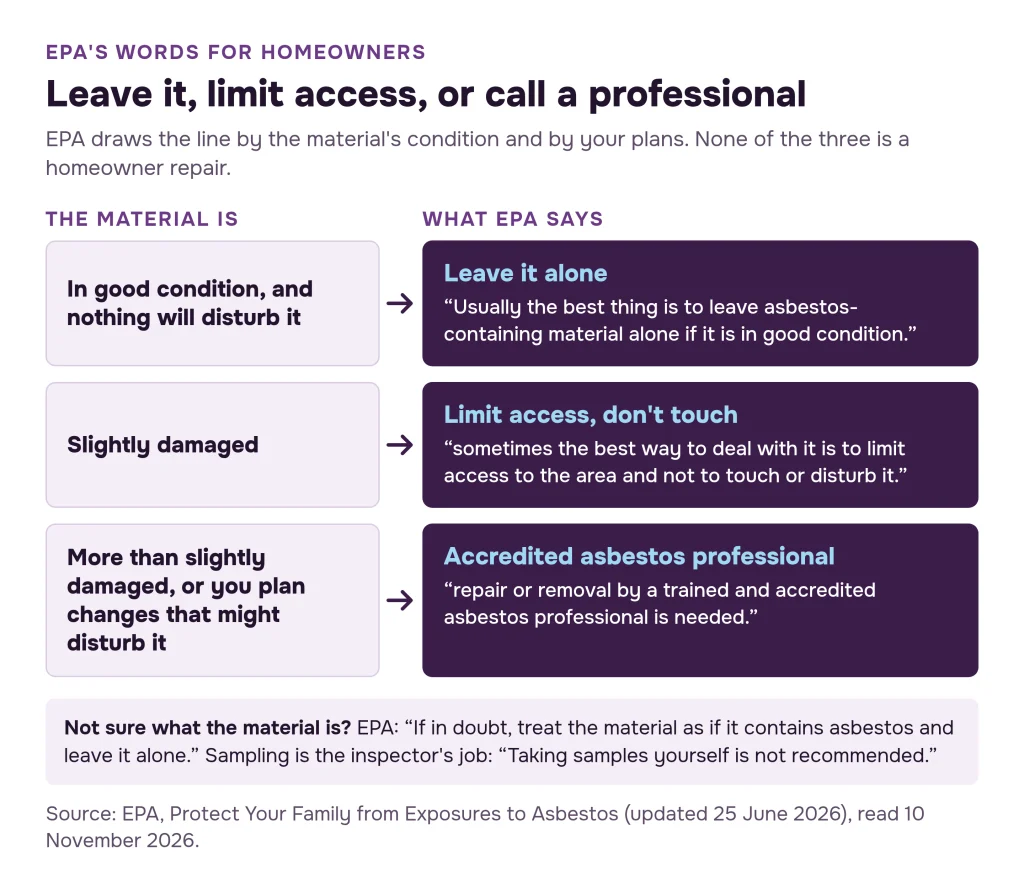
EPA draws the line by condition and by plans:
- Good condition, and nothing will disturb it: leave it alone. EPA says you don’t need to have the house tested in that case.
- Slightly damaged: “sometimes the best way to deal with it is to limit access to the area and not to touch or disturb it.”
- More than slightly damaged, or you plan changes that might disturb it: “repair or removal by a trained and accredited asbestos professional is needed.” EPA also suggests an inspection by an accredited professional before remodeling, or where insulation “is falling apart”.
EPA describes two kinds of professional. An asbestos inspector examines the house, takes samples for a laboratory and gives a written evaluation. An asbestos contractor repairs or removes the material. Repair means sealing it (encapsulation) or covering it (enclosure), and the asbestos stays in place; EPA notes that pipe, furnace and boiler insulation “can sometimes be repaired this way”, only by a professional trained to handle asbestos. Removal, EPA says, “is complex and must be done only by a trained and accredited asbestos professional”. Neither is a homeowner job, and we give no steps for either. Our page on removing old insulation explains where that stop applies to attic work.
Three things from EPA’s page are worth knowing before you call anyone:
- Use two firms. The professional who assesses whether repair or removal is needed “should not be connected with an asbestos firm that does the actual repair or removal”.
- Ask for proof of training. Federal law does not require people who inspect, repair or remove asbestos in detached single-family homes to be trained and accredited, though some states and localities do. EPA’s advice is to make sure the workers you hire are, and to ask each one to document federal or state-approved training.
- Start with your state. State agencies keep the current lists of accredited professionals. EPA’s state asbestos contacts page (updated 1 October 2026) lists the office for each state.
“Can I take a sample myself?”
You may see this on other sites, with a mail-in kit attached. We checked it against EPA’s current homeowner page, and it isn’t what the page says: “Taking samples yourself is not recommended.” Sampling is the inspector’s job.
Two older government texts are softer, and you may run into them. The CPSC booklet named above, written with EPA and the American Lung Association and still online, carries the same warning and then describes what to do “if you nevertheless choose to” sample. The Lung Association’s own statement at the end of that booklet says asbestos “should not be handled, sampled, removed or repaired by anyone other than a qualified professional”. And ENERGY STAR’s attic pages, the DIY checks page above and its attic insulation project page, say not to disturb vermiculite “unless you have had it tested by an approved lab”, while EPA’s vermiculite page says testing is “not necessary to take the appropriate precautions”. Where they differ, this site follows EPA’s asbestos pages.
Before you insulate or air seal an older house
Insulation work is exactly the kind of job that disturbs things. Before any of it, look at the places the work will touch:
- The attic floor. Vermiculite is one of the stops in ENERGY STAR’s attic guidance for homeowners, and EPA’s rule is not to disturb it. Nothing gets blown over it, raked level or sealed around by you. See the stop list in our attic insulation guide.
- The basement or crawl space. Sealing and insulating around the top of the foundation puts you beside the heating pipes, the boiler or furnace and its ducts. If any of them carries an old covering, treat it as suspect and keep the work clear of it. If the job can’t be done without touching, brushing against or cutting near that covering, stop: EPA’s line is that changes that might disturb the material need a trained and accredited asbestos professional first.
- Holes and chases. Air sealing the attic means working at the gaps around pipes, flues and ducts. An old wrap that runs through one of those gaps is a stop.
Tell every contractor and energy auditor what you’ve seen before they start, so they don’t find it with a saw. Once the stops are ruled out, our insulation calculator estimates how much to add for your climate zone.
Is asbestos insulation banned?
Partly, and in stages. EPA’s regulatory history lists these steps:
| Year | What happened |
|---|---|
| 1973 | EPA banned spray-applied asbestos surfacing material for fireproofing and insulating |
| 1975 | EPA banned installing asbestos pipe insulation and asbestos block insulation on facility components such as boilers and hot water tanks, where the material is pre-formed and friable, or wet-applied and friable after drying (“friable” is the rule’s term for material with more than 1 percent asbestos that, when dry, can be crumbled, pulverized or reduced to powder by hand pressure; it is a regulator’s definition, never a test to try) |
| 1977 | CPSC banned asbestos in artificial fireplace embers and wall patching compounds |
| 1989 | EPA issued a rule banning most asbestos products; most of it was overturned in court in 1991, leaving five product types and all new uses banned |
| 2019 | EPA rule: discontinued asbestos products, insulation among them, can’t return to the market without EPA review |
| 2024 | In March, EPA banned the ongoing uses of chrysotile, the only form of asbestos known to be still imported, processed or distributed in the United States |
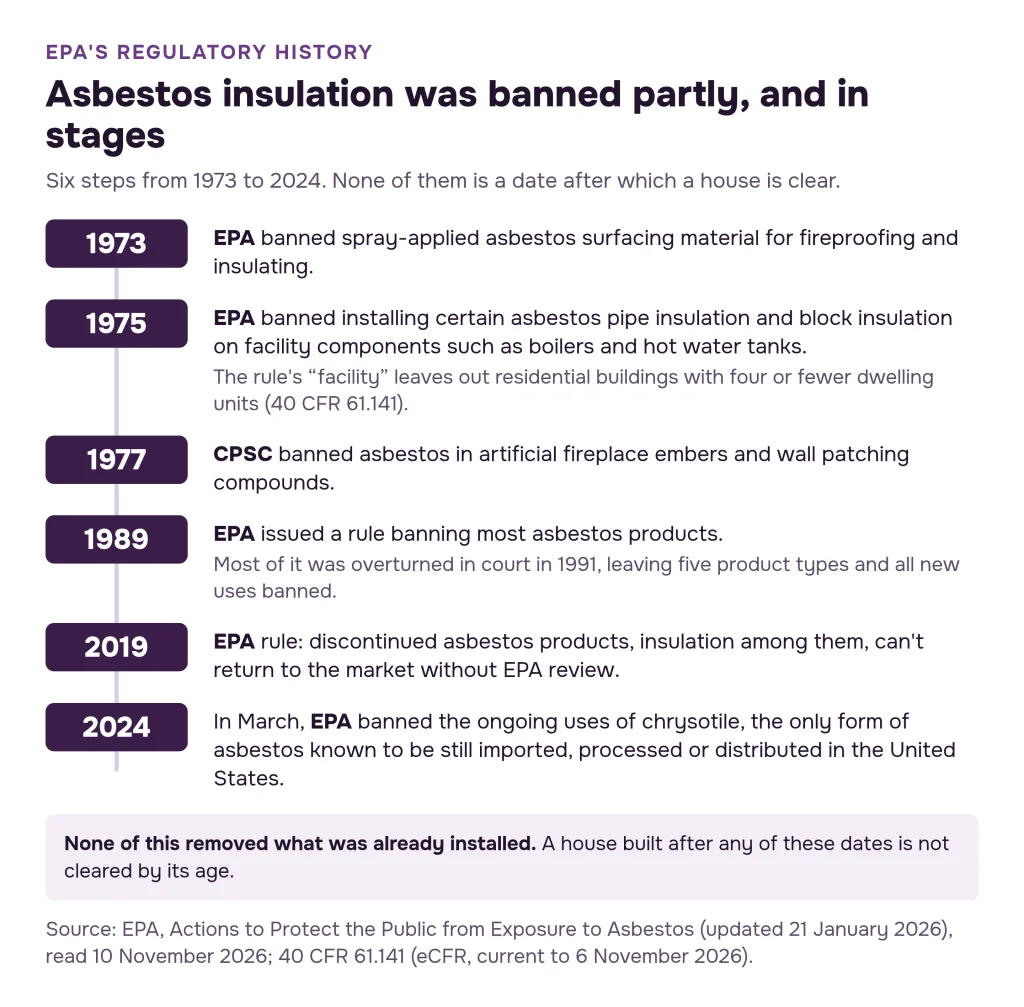
None of this removed what was already installed, and none of it is a date after which a house is clear. The 1975 ban covered installing certain pipe and block insulation, not every asbestos product, and the rule it sits in defines “facility” to leave out residential buildings with four or fewer dwelling units (40 CFR 61.141), so it was never a rule about single houses. The mine near Libby, Montana, supplied over 70 percent of the vermiculite sold in the United States from 1919 to 1990, and its vermiculite was contaminated with asbestos (EPA). You will see “homes built after 1980 have no asbestos” on other sites. We found no federal source that says so, and the dates above don’t support it.
Help with the cost: vermiculite only
One fund exists for one kind of asbestos insulation. The Zonolite Attic Insulation Trust reimburses part of the cost of removing or containing Zonolite-brand vermiculite, and it decides each claim. Its FAQ page (read 10 November 2026) says plainly that other asbestos-containing materials “such as pipe insulation” are not included. The trust says it is “not a government sponsored program”. Its site carries its own instructions for sending in a sample of the insulation; EPA’s line is that taking samples yourself is not recommended, so if a claim needs one, that is a job for a trained and accredited asbestos professional. We know of no national fund for pipe or boiler insulation; your state asbestos office is the place to ask about local help.
Your next step
- Look, don’t touch. From the hatch and from the basement floor, note what you see: fibers or pebbles in the attic, any old covering on pipes, the boiler, the furnace and its ducts, any board or paper behind a stove.
- Judge its condition from where you stand. Tears, abrasions, water damage, pieces on the floor.
- Intact and out of the way: leave it, keep people and stored things away from it, and check it now and then.
- Damaged, crumbling, or in the path of planned work: keep everyone out of the area, don’t sweep or vacuum, and call an accredited asbestos inspector found through your state’s asbestos office. Hire the contractor separately.
- Worried about a past exposure: EPA’s advice is to talk to your doctor.
Sources checked on 10 November 2026.
Sources
- EPA: Protect Your Family from Exposures to Asbestos (updated 25 Jun 2026)
- EPA: Learn About Asbestos (updated 13 Jul 2026)
- EPA: Protect Your Family from Asbestos-Contaminated Vermiculite Insulation (updated 17 Apr 2026)
- EPA: EPA Actions to Protect the Public from Exposure to Asbestos, with regulatory history (updated 21 Jan 2026)
- EPA: Risk Management for Asbestos, Part 1: Chrysotile Asbestos (updated 22 Oct 2026)
- EPA: State Asbestos Contacts (updated 1 Oct 2026)
- eCFR: 40 CFR Part 61, Subpart M, National Emission Standard for Asbestos, sections 61.141 and 61.148 (current to 6 Nov 2026; read in a browser)
- CPSC, EPA and American Lung Association: Asbestos in the Home (booklet, undated on the page)
- ENERGY STAR: DIY Checks and Inspections (live page, no date)
- ENERGY STAR: Attic Insulation Project (live page, no date)
- DOE Energy Saver: Insulation Materials (archived 19 Jun 2026; live page removed)
- Zonolite Attic Insulation Trust: FAQs (as live on 10 Nov 2026)