Most old insulation is harmless and can stay where it is, with new insulation added on top. A few things found in older houses change the job completely: pebbly attic fill that may be vermiculite, old wrap on heating pipes and boilers that may be asbestos, knob-and-tube wiring, and insulation that is wet, moldy or fouled by animals. Each is a reason to stop before any insulation or air sealing starts.
General information, not professional advice. Building codes are adopted locally, with changes, and your building department decides what applies to your house. Stop and call a qualified professional for anything this page marks as a stop.
The Insulation Book sells nothing, names no contractors and gives no prices for removal or asbestos work. These pages carry no sampling, removal or wiring steps.
First, work out what you are looking at
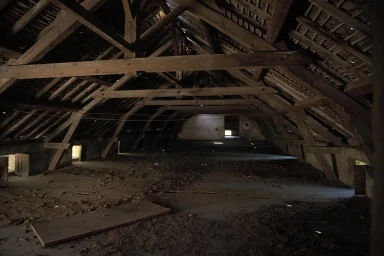
Look from the attic hatch with a flashlight. Don’t dig, rake, scoop or push a ruler into anything to find out what it is. ENERGY STAR’s attic check sorts loose insulation by what you see (DIY checks and inspections, read 10 November 2026): loose fibers are probably fiberglass, rock wool or cellulose, and lightweight granules are probably vermiculite or perlite. Fluff or shredded paper is one thing; small, light pebbles or flakes are another.
“Probably” is ENERGY STAR’s own word, and newer batts or loose fill can sit over older material. For anything you can’t name, the Environmental Protection Agency (EPA) gives the rule: “If in doubt, treat the material as if it contains asbestos and leave it alone” (Protect Your Family from Exposures to Asbestos, updated 25 June 2026).
Pebbly fill in the attic: vermiculite
EPA describes vermiculite insulation as “a pebble-like, pour-in product” that is “usually gray-brown or silver-gold in color”. Vermiculite itself is not asbestos, but a mine near Libby, Montana, supplied over 70 percent of the vermiculite sold in the United States from 1919 to 1990, and that vermiculite was contaminated with asbestos. So EPA’s instruction is short: assume the vermiculite contains asbestos and do not disturb it. Don’t store things in that attic, don’t let children play there, don’t try to remove it yourself, and hire a professional asbestos contractor before any remodeling or renovation that would disturb it (EPA vermiculite page, updated 17 April 2026).
You don’t need a lab test to start. EPA says “further testing is not necessary to take the appropriate precautions”, and that a test “might give you erroneous results”. ENERGY STAR’s attic pages say not to disturb vermiculite unless an approved lab has tested it. Where the two differ, this site follows EPA’s asbestos pages and treats a vermiculite attic as a stop for every do-it-yourself job, tested or not, including blowing new insulation over the top.
Our guide to vermiculite insulation and what EPA says to do has EPA’s full list, what to do if granules have come down into the house, and how EPA says to hire an accredited asbestos professional. It also covers the Zonolite Attic Insulation Trust, a private trust, not a government program, that pays partial reimbursement for professional removal or containment of Zonolite-brand vermiculite only. The trust cut its rate in a notice dated 7 October 2026, and claims filed on or before 30 November 2026 are treated differently from later ones; the page has the figures as we read them on 10 November 2026.
Old wrap on pipes, boilers and ducts: asbestos
Asbestos was used around things that get hot. EPA and the Consumer Product Safety Commission list coatings, blankets and tape on hot water and steam pipes, blankets and paper tape on boilers and furnace ducts, and paper, millboard or cement sheets around old stoves and furnaces. None of it can be confirmed by eye. EPA: “Generally, you can’t tell whether a material contains asbestos simply by looking at it, unless it is labeled.”
What matters is condition and whether work will disturb it. EPA says asbestos-containing materials that aren’t damaged or disturbed “are not likely to pose a health risk”, and that material in good condition is usually best left alone. If it is more than slightly damaged, or you plan changes that might disturb it, “repair or removal by a trained and accredited asbestos professional is needed”. EPA does not recommend taking samples yourself.
An old covering in the way of insulation or air sealing work is a stop. Asbestos insulation: where it turns up and what EPA says to do covers the places, how to tell the common attic materials apart without touching them, EPA’s do’s and don’ts, and what the federal bans did and did not cover.
Wires on porcelain knobs: knob-and-tube
Knob-and-tube wiring is single wires run through attics and walls on porcelain knobs and through porcelain tubes. ENERGY STAR dates it “pre-1930” and lists it among the conditions that call for a professional before an attic project, because it “can be a fire hazard when in contact with insulation” (attic insulation project page, read 10 November 2026). If any of it may still be live, don’t put insulation over or around it, don’t pull back insulation that already covers it, and don’t touch the wires. Only a licensed electrician who tests the circuits can say whether it is live.
Wiring comes first, insulation second. Our page on knob-and-tube wiring and insulation explains the model electrical code item we read and the three states whose rules we read that allow insulation after an electrical professional’s inspection: Washington, Oregon and California. None lets a homeowner decide alone. For every other state the answer is “not confirmed”: ask your building department or state electrical board.
Does the old insulation have to come out?
Usually not. Age, dust and a gray color are not reasons. ENERGY STAR’s do-it-yourself guide says of insulation darkened by leaking air: “Although the insulation is dirty, it is still okay to use. There’s no need to remove and replace.”
Condition decides. The federal health and environment agencies say insulation is discarded when floodwater or sewage reached it, when it got wet from a leak, when it is moldy, or when rodents, bats, birds or raccoons fouled it. The cause comes first: the roof leak, the vent blowing into the attic, the animals’ way in. And settle what the material is before anyone moves it.
Insulation removal: when old insulation has to come out sets out each agency’s line, what to ask a removal contractor, and the paperwork the Federal Trade Commission’s R-value Rule requires for the new insulation: the maker’s fact sheet before you buy and a dated, signed receipt after. It gives no removal steps.
A newer hazard: two-part spray foam kits
A two-part spray foam kit is a pair of pressurized tanks that mix at the gun, and one side is isocyanates, chemicals that EPA’s archived pages say may cause skin, eye and lung irritation, asthma and sensitization. Consumer Product Safety Commission staff say that with kits “the same precautions should be taken as with professional use” and advise that residents vacate for at least 24 hours after spray foam is installed (CPSC staff fact sheet, December 2019, file updated May 2025; staff guidance).
Kits also meet the other items on this page: Washington and Oregon bar foam with knob-and-tube wiring, and a vermiculite attic is not worked in at all. DIY spray foam kits: what the label and CPSC say first explains what is in the tanks, what one maker’s manual requires and why a “one-hour re-entry” claim comes with conditions. It explains kits; it does not walk through using one.
Once the stops are cleared
With the material named, the wiring settled and any damage and its cause dealt with, the order is to seal first, then insulate: air sealing the attic comes before new insulation, and the attic insulation guide has the full order of work. Our how much insulation do I need tool estimates what to add for your climate zone.
After any work that tightens the house, ENERGY STAR’s guide says to have your heating and cooling technician check the combustion appliances (gas or oil furnace, water heater and dryer) for proper venting. Keep working carbon monoxide alarms.
Your next step
- Look, don’t touch. From the hatch and from the basement floor, with a flashlight: fibers or granules in the attic, any old covering on pipes, the boiler, the furnace and its ducts, any porcelain knobs or single wires.
- Granules, or anything you can’t name: treat it as if it contains asbestos, close the attic to storage and to children, and put attic projects on hold.
- Knobs, tubes or single wires: hands off, and call a licensed electrician before any insulation or air sealing in those spaces.
- Wet, moldy or fouled insulation: find and fix the cause first.
- If asbestos work is needed, start from EPA’s state asbestos contacts (updated 1 October 2026) to find accredited inspectors and contractors.
Sources checked on 10 November 2026.