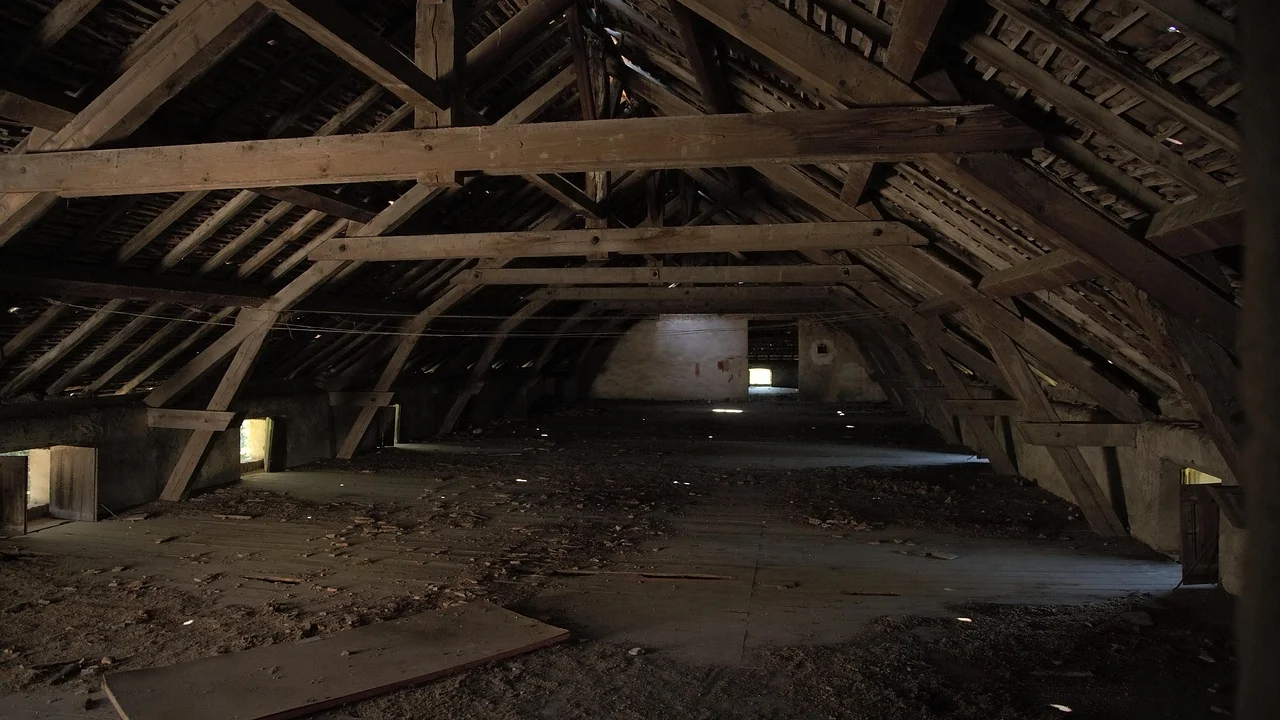
Vermiculite insulation is the loose, pebbly, gray-brown or silver-gold fill found in the attics and walls of some older houses. The Environmental Protection Agency’s instruction is short: assume it contains asbestos and do not disturb it. Don’t store things in that attic, don’t let children play there, don’t try to remove it yourself, and hire a trained, accredited asbestos professional before any work that would disturb it. You don’t need a lab test to start doing any of that.
This page is part of our guide to old insulation and safety. It sets out what EPA says in its own words, how to recognize vermiculite without touching it, where other official pages say something different, and what the Zonolite trust pays toward professional removal. The Insulation Book sells nothing and refers no contractors.
General information, not professional advice. Building codes are adopted locally, with changes, and your building department decides what applies to your house. Stop and call a qualified professional for anything this page marks as a stop.
What EPA says to do
EPA’s page, Protect Your Family from Asbestos-Contaminated Vermiculite Insulation (last updated 17 April 2026), puts its main line in capitals: “YOU SHOULD ASSUME THE VERMICULITE CONTAINS ASBESTOS AND DO NOT DISTURB IT!” Its five recommendations follow, word for word:
- Leave vermiculite insulation undisturbed in your attic or in your walls.
- Do not store boxes or other items in your attic if it contains vermiculite insulation.
- Do not allow children to play in an attic with vermiculite insulation.
- Do not attempt to remove the insulation yourself.
- Hire a professional asbestos contractor if you plan to remodel or conduct renovations that would disturb the vermiculite in your attic or walls to make sure the material is safely handled and/or removed.
Two more lines on the same page matter in daily life. If you absolutely have to go into the attic, EPA says to “limit the number of trips you make and shorten the length of those trips”. And for walls: “We do not recommend that you open your walls to check for vermiculite.”
That is the whole instruction. Nothing in it is a job for the homeowner, and that is the point: the list is things not to do, plus one phone call before work starts.
What vermiculite looks like
EPA describes vermiculite insulation as “a pebble-like, pour-in product” that is “usually gray-brown or silver-gold in color”. The raw mineral is made of shiny flakes that resemble mica; heated, the flakes expand to 8 to 30 times their size into a lightweight, fire-resistant, odorless material. Pieces range from very fine particles to coarse ones nearly an inch long. ENERGY STAR’s attic pages call it “a lightweight, pea-size, flaky gray mineral”.
EPA’s page has five photos, including one with a paper clip for scale. Its advice on using them: “Look at the photos on this website and then look at the insulation without disturbing it.” In practice that means looking from the hatch with a flashlight. Don’t scoop a handful, don’t rake it aside to see what is underneath, and don’t push a ruler into it to measure the depth.
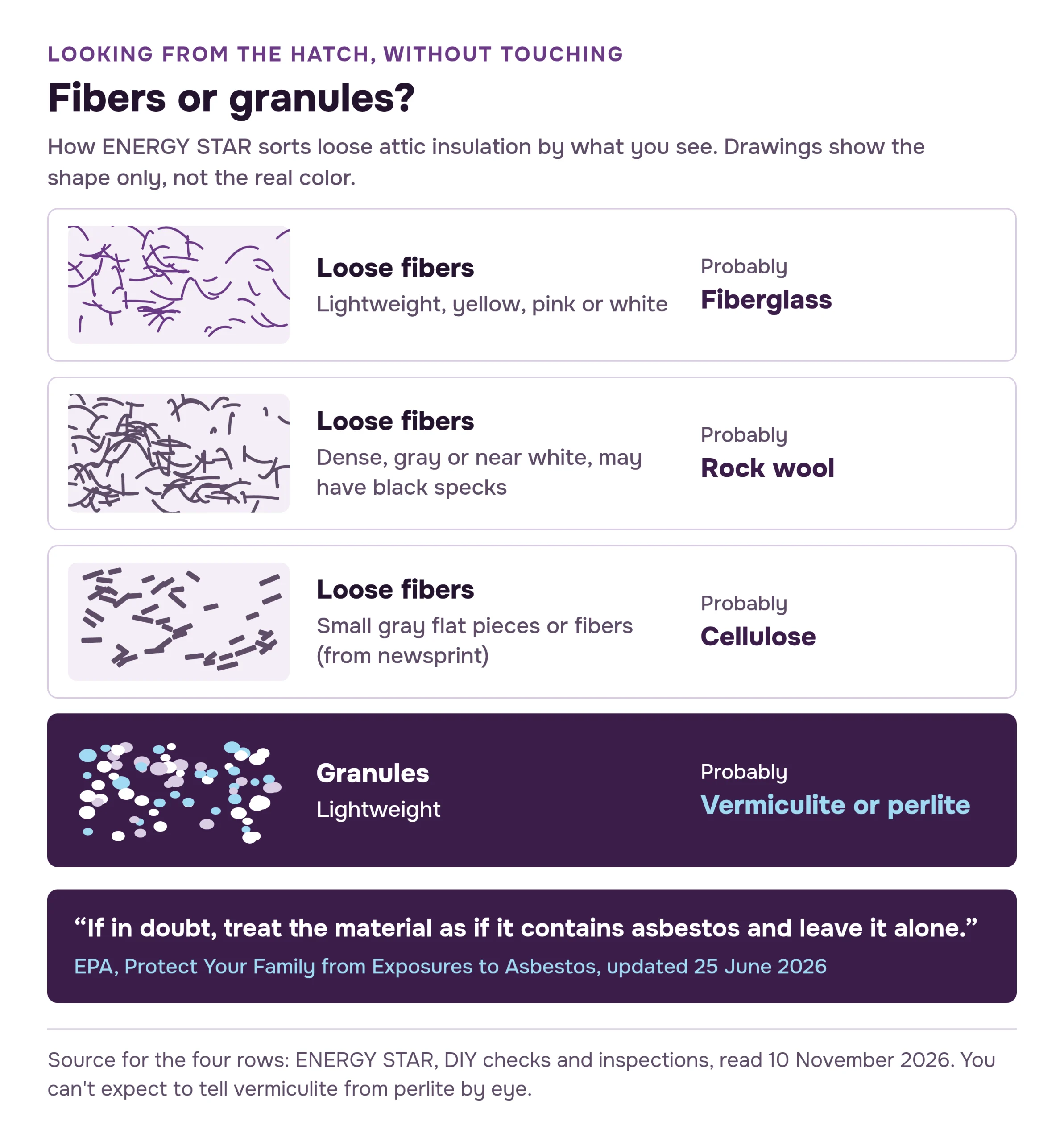
ENERGY STAR’s attic inspection page (read 10 November 2026) sorts loose attic insulation by what you see:
| What you see | What it probably is (ENERGY STAR) |
|---|---|
| Loose fibers, lightweight, yellow, pink or white | Fiberglass |
| Loose fibers, dense, gray or near white, may have black specks | Rock wool |
| Loose fibers, small gray flat pieces or fibers (from newsprint) | Cellulose |
| Granules, lightweight | Vermiculite or perlite |
The useful split is fibers against granules. Fiberglass, rock wool and cellulose look like fluff or shredded paper. Vermiculite looks like small, light pebbles or flakes with a slight glint. ENERGY STAR puts vermiculite and perlite, another expanded mineral, in the same row, so you can’t expect to settle it by eye. EPA’s general asbestos page gives the rule for that case: “If in doubt, treat the material as if it contains asbestos and leave it alone.”
Vermiculite can also be out of sight. The Zonolite trust (below) asks home inspectors to note whether the vermiculite they find is “concealed or obvious”. A newer layer of batts or loose fill on top doesn’t prove there are no granules beneath it, and digging to find out is exactly the disturbance EPA warns against. If you have a reason to suspect it, such as granules at the hatch edge or a note in an inspection report, treat the attic as a vermiculite attic.
Why assume asbestos: Libby and Zonolite
Vermiculite itself is not asbestos. EPA’s short answer on the mineral (updated 9 April 2026) says asbestos “is not intrinsic to vermiculite and only a few ore bodies have been found to contain more than tiny trace amounts”. The trouble is that one of those few ore bodies supplied most of the country.
In EPA’s words, a mine near Libby, Montana, “was the source of over 70 percent of all vermiculite sold in the United States from 1919 to 1990. There was also a deposit of asbestos at that mine, so the vermiculite from Libby was contaminated with asbestos.” Libby vermiculite went into the majority of US vermiculite insulation and was often sold under the brand name Zonolite.
EPA’s Superfund profile of the Libby site (read 10 November 2026) gives the outline:
- 1881: gold miners discover vermiculite at Libby.
- 1920s: the Zonolite Company forms and starts mining it.
- 1963: W.R. Grace buys the Zonolite mining operations.
- 1990: the mine closes. While it ran, EPA says, it “may have produced 80 percent of the world’s supply of vermiculite”.
- 1999 to 2002: EPA responds to local concern in 1999, starts removal work in 2000 and puts the site on the Superfund National Priorities List in October 2002.
- 2009: EPA and the Department of Health and Human Services declare a public health emergency in Libby, the first such declaration in EPA’s history.
- 2018: EPA finishes investigating and cleaning most of the site, including more than 2,600 homes and businesses in Libby and Troy. The former mine and the forest around it are still to be dealt with.
The asbestos in Libby vermiculite is a kind EPA calls Libby Amphibole asbestos and describes as “highly friable”, meaning it crumbles and gets into the air easily.
The trust set up to deal with Zonolite says the product was sold as attic insulation from the 1940s to the mid-1980s and estimates that about 75% of the vermiculite in US homes is the Zonolite brand. So some vermiculite is not from Libby. EPA’s instruction doesn’t change for that share, and it doesn’t ask you to work out where yours came from: “You should assume that vermiculite insulation is from Libby and treat the material as if it contained asbestos”. EPA’s page gives no test based on the age of the house either.
Do you need to test it?
Not to take the precautions. EPA says that because of Libby’s share of the market, “further testing is not necessary to take the appropriate precautions”. It adds a warning about testing itself: “While you can hire a trained professional to test your attic for asbestos, this may be expensive and, depending on the methods used, might give you erroneous results.”
You will see other official wording, and it helps to know where each line comes from.
| Source | What it says | What the test is for |
|---|---|---|
| EPA vermiculite page, updated 17 April 2026 | Assume it contains asbestos. Testing is not necessary to take precautions, may be expensive and may give erroneous results | Nothing you need before leaving it alone |
| ENERGY STAR DIY guide (EPA 430-F-04-024, 2016 text, page 1.7) and its attic project pages | “Don’t disturb vermiculite insulation unless you’ve had it tested by an approved lab to be sure it doesn’t contain asbestos.” Ask your local health department for a lab | Clearing the attic for do-it-yourself work |
| Zonolite Attic Insulation Trust, FAQs read 10 November 2026 | A claim must show that the vermiculite is the Zonolite brand | Identifying the brand for a reimbursement claim, not deciding whether the attic can be worked in |
ENERGY STAR is an EPA program, but its line is the softer of the two: it leaves a door open to working in the attic after a clean lab result. EPA’s asbestos program tells you to assume asbestos without a test, and warns that a test result can be wrong. This site follows EPA’s asbestos page. We treat a vermiculite attic as a stop for every do-it-yourself job on this site, tested or not.
If a sample is ever needed, for the trust or before a renovation, it is not yours to take. EPA’s page Protect Your Family from Exposures to Asbestos (updated 25 June 2026) says: “if done incorrectly, sampling can be more hazardous than leaving the material alone. Taking samples yourself is not recommended.” A trained and accredited asbestos professional takes it.
How the risk arises
EPA states the health position in two sentences: “Asbestos causes cancer and other diseases. There is no known safe level of asbestos exposure.” The fibers have to be in the air to be breathed in, which is why everything turns on not disturbing the material. On the other side of that, EPA says: “If you do not go into your attic, handle, or disturb the insulation, it is likely that you will not be exposed to asbestos fibers from vermiculite insulation.”
EPA also asks you to think about other people’s work. Disturbance “possibly by a contractor doing work in your attic” may leave fibers in other parts of the house. So before an electrician, a roofer, a cable installer, a heating technician or an energy auditor goes into that attic, tell them what is up there.
If granules have come down into the house
Granules sometimes appear below a hatch, a ceiling fixture or a crack. EPA’s general asbestos page says: “Don’t dust, sweep, or vacuum debris that may contain asbestos” and don’t track it through the house. It says to call an asbestos professional if the material comes from a damaged area or a large area must be cleaned. Keep people out of that spot and make the call.
If you have already handled it
Many people learn what vermiculite is after they have moved boxes through it or cleaned some of it out. EPA’s answer is honest about the limits: “It is not possible to say whether your exposure may result in disease.” It says the risk rises with the level, duration and frequency of exposure, that disease may not appear until decades later, and that smoking makes the risk worse. If you are concerned, EPA says to talk to your doctor and consider a physician who specializes in lung diseases. Stop the activity now; the rules above apply from today.
What it means for an insulation project
Almost every attic job this site explains means working in the insulation: pulling it back to seal air leaks in the attic floor, fitting baffles at the eaves, damming recessed lights and flues, or blowing in loose fill across the top. In a vermiculite attic none of those is a do-it-yourself job. ENERGY STAR’s attic sealing and attic insulation project pages carry the vermiculite caution in their safety notes, and we treat it as a hard stop, alongside ENERGY STAR’s other reasons to bring in a professional, such as wet insulation, moldy framing and knob-and-tube wiring.
That includes adding new insulation over the top. We found no EPA page that tells homeowners to cover vermiculite with more insulation. EPA’s instruction is to leave it undisturbed, and laying or blowing insulation means walking and working in it.
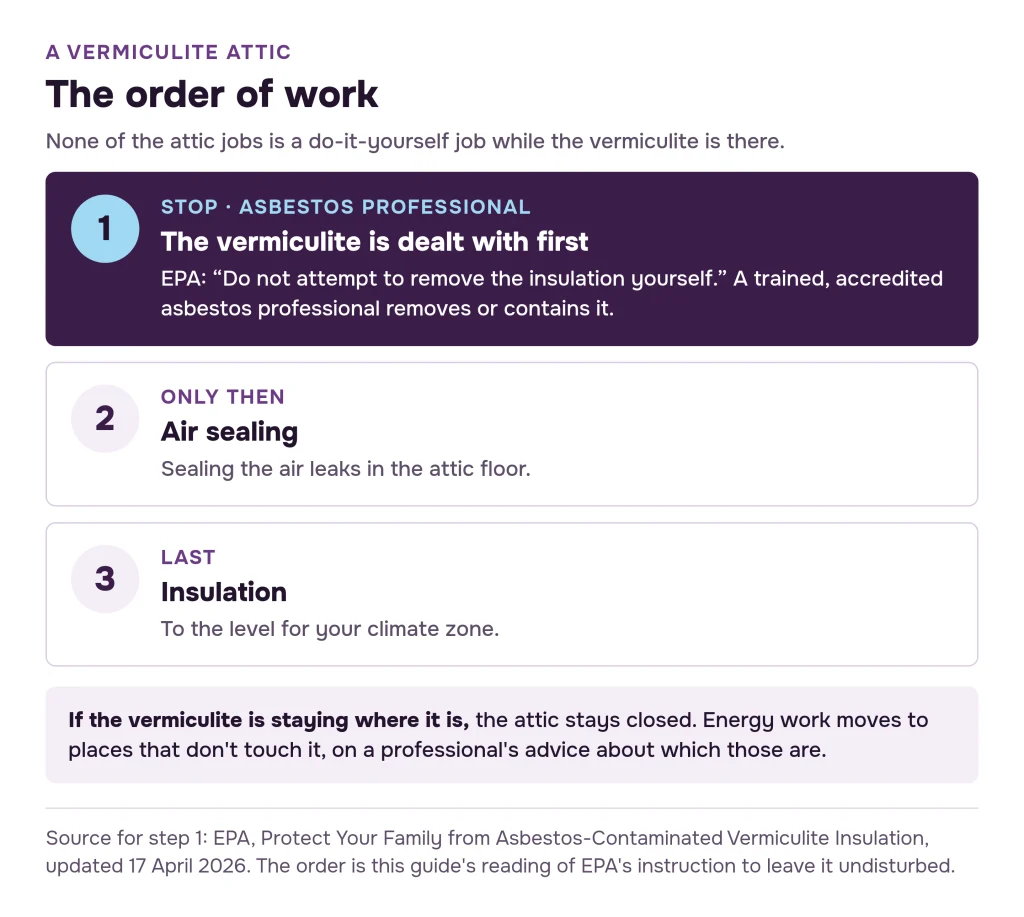
The order of work is therefore fixed. An asbestos professional deals with the vermiculite first. Only then does the rest of the attic insulation plan start: air sealing, then insulation to the level for your climate zone. If the vermiculite is staying where it is, the attic stays closed, and your energy work moves to places that don’t touch it, on a professional’s advice about which those are.
If you are applying for free weatherization help, expect the attic to be an issue. The Zonolite trust says it is aware that some homes that would otherwise qualify “are being deferred due to the presence of vermiculite in the attic”, and that where an agency has funds for vermiculite work, the trust lets the agency pay the homeowner’s share to the contractor. Ask your local agency how it handles vermiculite.
Hiring an asbestos professional
EPA’s general asbestos page describes two kinds of accredited professional. Asbestos inspectors inspect, assess, take samples and advise on what is needed. Asbestos contractors repair or remove the material. Its points for homeowners, as read on 10 November 2026:
- Keep the two roles apart. The professional who assesses whether work is needed “should not be connected with an asbestos firm that does the actual repair or removal”. EPA says two different firms are better.
- Ask for proof. Each person doing the work should show proof of accreditation and completed federal or state-approved training.
- Know what the law does and doesn’t require. Federal law does not require people who inspect, repair or remove asbestos in detached single-family homes to be trained and accredited. Some states and localities do. EPA says homeowners should make sure the workers they hire are trained and accredited either way.
- Use your state’s list. EPA says state agencies keep the most current lists of accredited professionals. Start from its state asbestos contacts (updated 1 October 2026), which is also where to ask about your state’s own rules.
- Check their record. EPA suggests asking your local air pollution control board, the local worker safety agency and the Better Business Bureau about past violations.
- Get it in writing. Before work begins, a written contract should set out the work plan, the cleanup and the federal, state and local rules the contractor must follow. At the end, get written assurance that all procedures were followed.
- Consider a check afterward. EPA says an inspector or independent air testing contractor may monitor the air after the job to confirm there is no increase in asbestos fibers.
Removal is not the only thing a professional may propose. EPA’s page also describes repair, which means sealing or covering asbestos material so fibers are not released, and the Zonolite trust reimburses work to “remove or contain” vermiculite. Which approach fits loose fill in your attic is the professional’s judgment and your state’s rules, not a homeowner project. EPA is plain about both: sealing “should be done only by a professional trained to handle asbestos safely”, and removal “must be done only by a trained and accredited asbestos professional”.
We don’t give prices for this work or name firms. For other old materials, see our pages on asbestos insulation on pipes, boilers and ducts and on when old insulation has to come out.
The Zonolite Attic Insulation Trust
There is money toward professional work, with conditions. The Zonolite Attic Insulation Trust, known as the ZAI Trust, was funded by W.R. Grace under a court-approved class action settlement. It is independent, it is not a government program, and it is not part of EPA. It pays a partial reimbursement of what a property owner or renter has spent to have Zonolite-brand vermiculite removed or contained. It covers all 50 states and both homes and commercial buildings.
The trust announced a cut in its payment rate in a notice dated 7 October 2026, and one date in that notice is close: 30 November 2026. These are the figures in the trust’s notice and FAQs as we read them on 10 November 2026.
| Item | What the trust says |
|---|---|
| What qualifies | Only Zonolite-brand vermiculite, which the trust puts at about 75% of the vermiculite in homes. The other 25% or so is not eligible |
| What it reimburses | Part of an “Allowed Value”: reasonable vermiculite removal or containment costs and reasonable re-insulation to replace what was removed |
| Largest Allowed Value, trust year 2026 (3 February to 2 February) | $9,813.61 |
| Claims filed on or before 30 November 2026, with every requirement met by 31 January 2027 | 55% of the Allowed Value, so at most $5,397.48 |
| Claims filed after 30 November 2026, or not complete by 31 January 2027 | 35.75% of the Allowed Value (65% of the old amount), so at most $3,508.36 |
| Deadline to file at all | None stated: “There is no deadline for filing the claim” |
| How long the trust will run | Until at least 2036, and likely until 2039 if valid claims are still coming in |
The higher rate needs more than a claim form by 30 November. The trust’s notice says you must also “complete your abatement and submit ALL required documentation” by 31 January 2027. That is a short window for professional work, and a date is a poor reason to hurry the choice of who does it. Read the figures with the trust’s own warnings beside them:
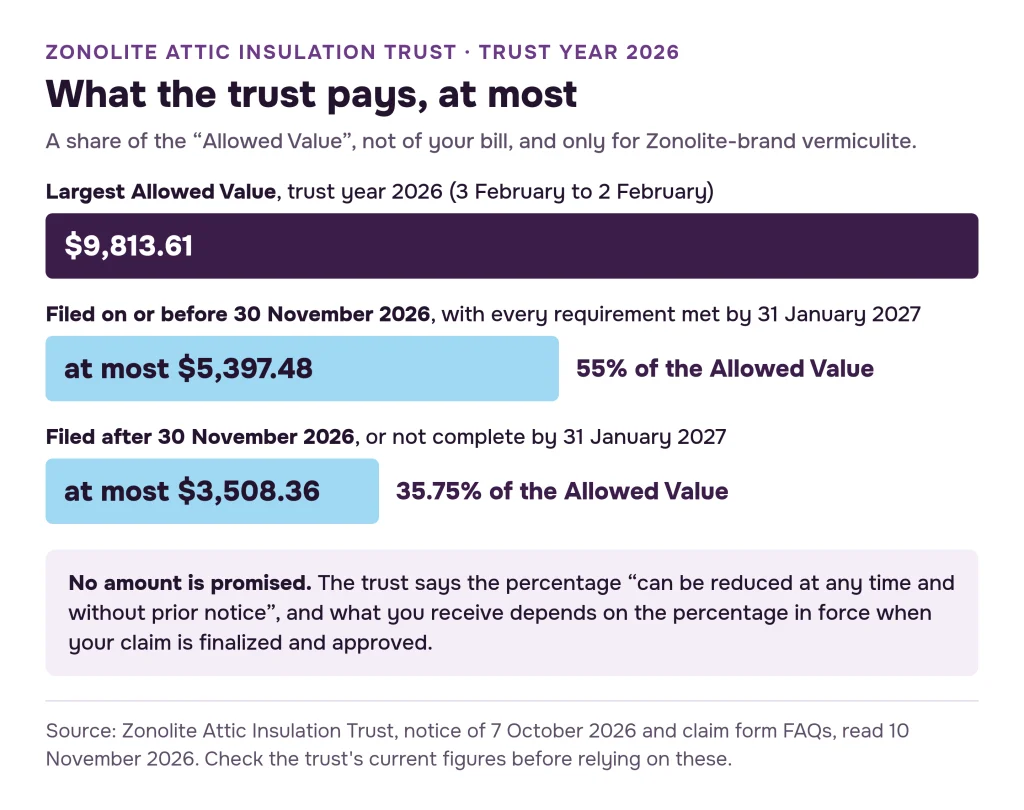
- The rate can fall again. The trust says the payment percentage “can be reduced at any time and without prior notice”, that it may cap the number of claims it approves in a year, and that what you receive depends on the percentage in force when your claim is finalized and approved. No amount is promised until the trustee approves the claim.
- You can open a claim before any work. The trust says you can start a claim even if you aren’t sure of the brand, that the claim stays pending until you have costs to submit, and that you are “under NO OBLIGATION” to have the insulation removed.
- It asks for proof of the brand. The trust lists a laboratory result, original Zonolite bags left in the attic, or an original receipt or invoice. Its site has its own instructions for samples; EPA’s position is that taking samples yourself is not recommended, so that is a job for an accredited asbestos inspector. A contractor’s assurance that you will qualify is not proof, the trust says.
- It asks for proof of payment and photos. The contractor’s proposal and invoice, a canceled check or a bank or card statement, and unaltered digital photos from before the work, after removal and after re-insulation. An invoice marked “paid” is not enough.
- Your own labor is not reimbursed. If you or a family member do the work, the trust does not pay for that labor. EPA’s instruction is not to remove it yourself in any case.
- Upgrades are deducted. Re-insulation is covered only to replace the vermiculite. The trust lists knob-and-tube removal, bath fans, vents, attic hatches, baffles and foam board among the extras it takes out of a claim, so ask for the vermiculite work to be itemized separately on the proposal and invoice.
- Other asbestos materials are outside it. Pipe insulation, floor tile, plaster and mold work are not covered.
- You don’t need to pay anyone to file. The trust says its process is designed to be completed without an attorney or a paid service.
If you are buying or selling a house with vermiculite, the trust says the parties can agree who has the right to the claim. Its disclaimers page (read 10 November 2026) says a seller may have a legal duty to disclose vermiculite, and tells sellers to consult a licensed real estate agent or an attorney about their state’s law. We can’t advise on that.
The trust decides each claim and its figures change. Use the trust’s own Get Started page for how to file, and check its current percentage before you rely on any number here.
Claims you may see elsewhere
We checked these against the sources above on 10 November 2026.
- “Test it before you decide what to do.” EPA says testing is not necessary to take precautions and may give erroneous results. The decision EPA asks of you, to leave it alone, doesn’t wait for a lab.
- “Only some vermiculite has asbestos, so yours is probably fine.” The first half is true. EPA’s conclusion is the opposite: assume it is from Libby and treat it as if it contained asbestos.
- “A careful homeowner can take it out with a shop vacuum and a mask.” EPA: “Do not attempt to remove the insulation yourself.” Its asbestos page tells homeowners not to dust, sweep or vacuum debris that may contain asbestos, and says of a professional’s cleanup: “A regular vacuum cleaner should never be used.”
- “The trust will pay 55%.” That is the original rate, and it now applies only to claims filed by 30 November 2026 and completed by 31 January 2027. For claims filed after 30 November 2026 the trust’s figure is 35.75% of the Allowed Value. Either way it is a share of the Allowed Value, not of the bill, only for Zonolite-brand material, and the trust says the rate can fall again.
- “Just blow new insulation over it.” EPA’s page does not say this. Working in the attic disturbs the material, and ENERGY STAR’s own pages tell do-it-yourselfers not to disturb it.
Your next step
- Look, don’t touch. Compare what you can see from the hatch with EPA’s photos. If it is granular, or you aren’t sure, treat it as vermiculite.
- Close the attic to everyday use. No storage, no children, as few trips as possible. EPA’s page doesn’t say how to get boxes that are already up there back out, so ask an asbestos professional before you move them.
- Tell the people who need to know. Everyone in the household, and any tradesperson before they open the hatch.
- Put attic projects on hold. No air sealing, no added insulation, no new wiring or fans through that ceiling until an asbestos professional has dealt with the vermiculite or told you how the work can be done.
- If work is planned, call your state’s asbestos program. Use EPA’s state contacts to find accredited inspectors and contractors and to ask what your state requires.
- If it may be Zonolite, read the trust’s site now. A claim filed by 30 November 2026 is treated differently from one filed after it.
- Stop if something changes. Granules in the living space, a ceiling that has come down, or water damage in that attic are reasons to keep out and call an asbestos professional.
This page is general information, not medical, legal or professional advice. The Insulation Book doesn’t sell insulation, testing or removal, and doesn’t refer contractors.
Sources checked on 10 November 2026.
Sources
- EPA: Protect Your Family from Asbestos-Contaminated Vermiculite Insulation (updated 17 Apr 2026)
- EPA: Protect Your Family from Exposures to Asbestos (updated 25 Jun 2026)
- EPA: What is Vermiculite? (updated 9 Apr 2026)
- EPA: State Asbestos Contacts (updated 1 Oct 2026)
- EPA: Libby Asbestos Superfund site profile, background and cleanup (read 10 Nov 2026)
- ENERGY STAR: A Do-It-Yourself Guide to Sealing and Insulating, EPA 430-F-04-024 (2016 text), page 1.7
- ENERGY STAR: DIY checks and inspections (read 10 Nov 2026)
- ENERGY STAR: Attic insulation project (read 10 Nov 2026)
- ENERGY STAR: Attic air sealing project (read 10 Nov 2026)
- Zonolite Attic Insulation Trust: About the ZAI Trust (read 10 Nov 2026)
- Zonolite Attic Insulation Trust: claim form FAQs, updated October 2026 (read 10 Nov 2026)
- Zonolite Attic Insulation Trust: Notice of Reimbursement Percentage Adjustment and Documentation Deadline (7 Oct 2026)
- Zonolite Attic Insulation Trust: home page (read 10 Nov 2026)
- Zonolite Attic Insulation Trust: Get Started (read 10 Nov 2026)
- Zonolite Attic Insulation Trust: Disclaimers (read 10 Nov 2026)
- Zonolite Attic Insulation Trust: Real Estate Professionals (read 10 Nov 2026)
- Zonolite Attic Insulation Trust: Weatherization Agencies (read 10 Nov 2026)
- Zonolite Attic Insulation Trust: Home Inspectors (read 10 Nov 2026)