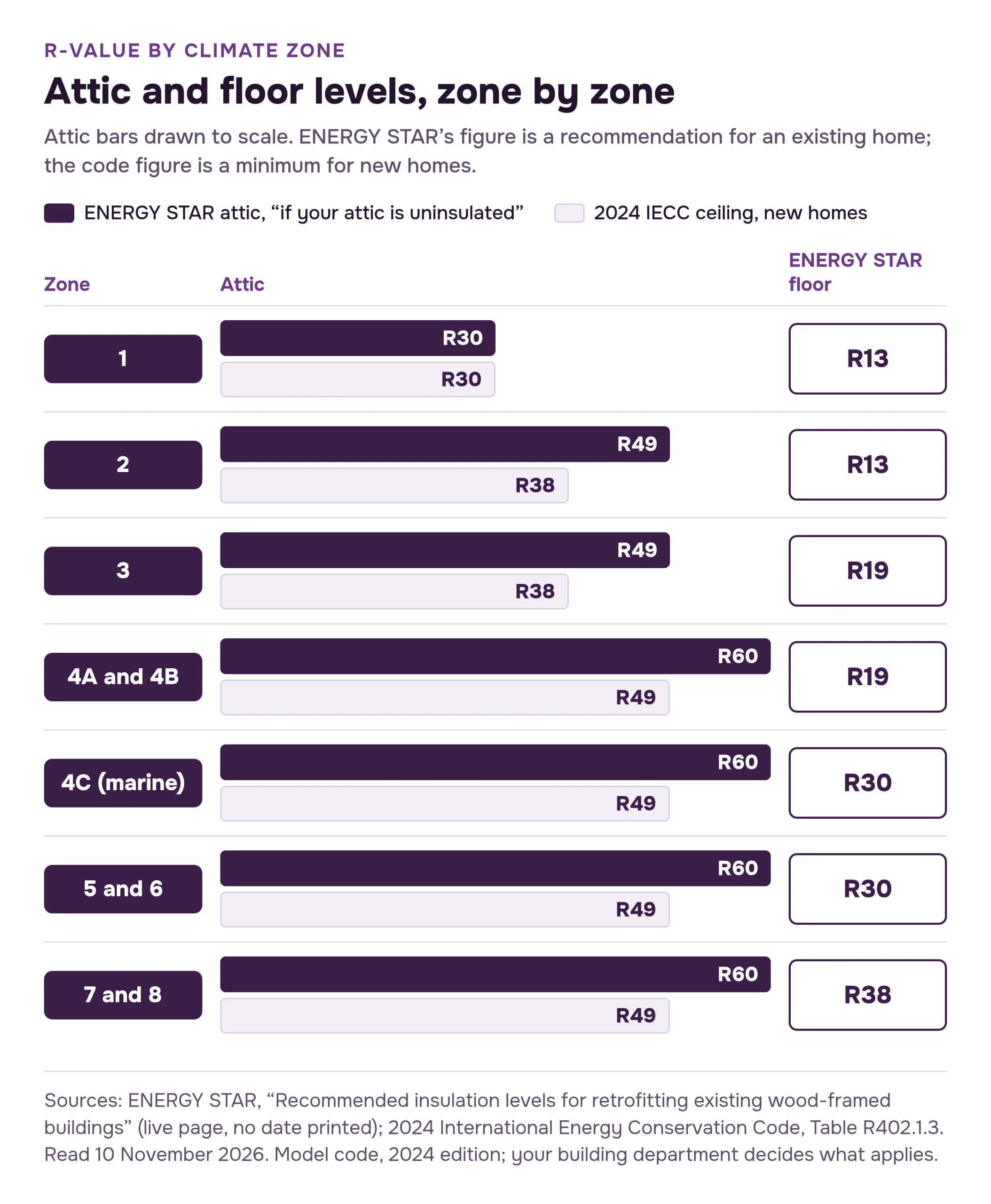
For an attic with no insulation, ENERGY STAR’s table for existing homes says R30 in climate zone 1, R49 in zones 2 and 3, and R60 in zones 4 to 8. The 2024 model energy code asks less of a new home: R30, R38 and R49. How much you need to add is the gap between your zone’s level and what is already up there, and the calculator on this page estimates that gap from a ruler reading. It is the starting point for every job in our attic guides, and it covers floors and walls too.
General information, not professional advice. Building codes are adopted locally, with changes, and your building department decides what applies to your house. Stop and call a qualified professional for anything this page marks as a stop.
The Insulation Book sells nothing and refers no one. Every figure below names the table it came from and the day we read it, because the tables do not agree with each other and you deserve to know which one you are looking at.
What to enter
- Climate zone. A number from 1 (hottest) to 8 (coldest), set county by county. If you don’t know yours, find it by state and county further down. Zone 4 is split: 4C, the marine strip of the Pacific Northwest, gets a higher floor level than 4A and 4B.
- Where. The attic floor, a floor over an unheated space, or a wall above ground. Attics and floors get a number. Walls get ENERGY STAR’s line in words, because its wall advice is not a single R-value.
- What is there now. Pick the description that matches what you see. These are ENERGY STAR’s descriptions, and each carries its rough R-value per inch. If you see light-weight granules, stop: that may be vermiculite, and the calculator gives no figure for it (see the stop below).
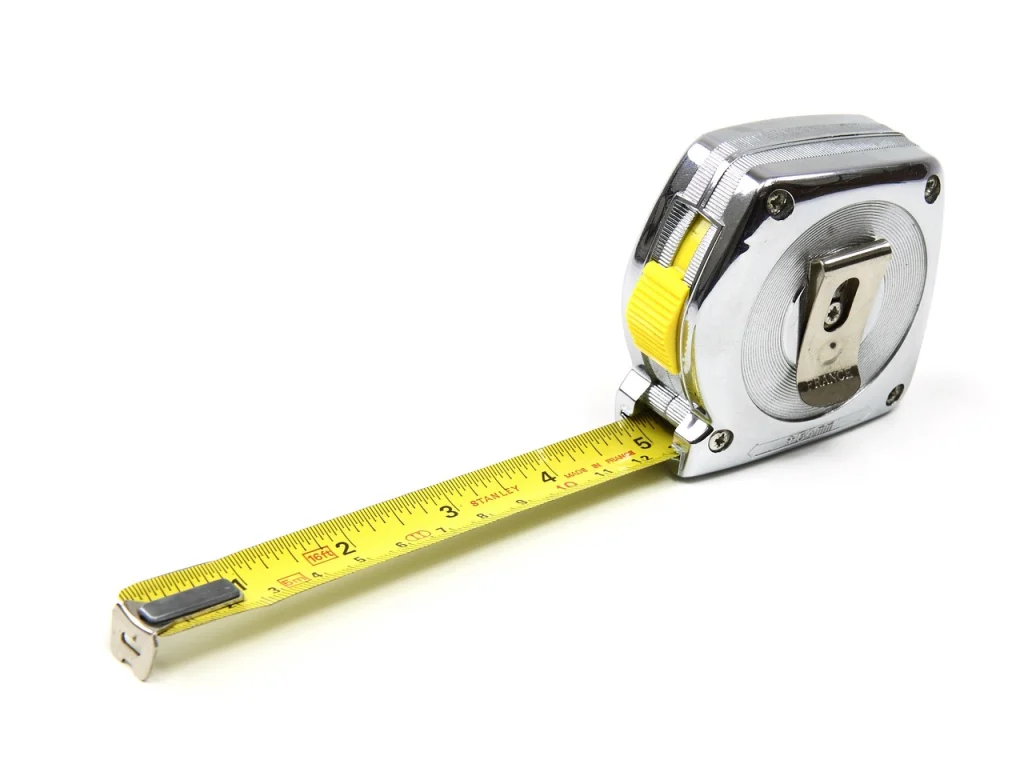
- Depth in inches. Read it off a ruler or against the joists, without stirring the insulation. A modern 2×6 joist is 5.5 inches tall, so insulation level with the top of 2×6 joists is about 5.5 inches deep; older joists can be a different size, so measure yours. Check a few spots you can reach from the joists, and use a typical depth.
The result is an estimate. It shows the estimated R-value you have, ENERGY STAR’s level for your zone, the R-value left to add (our subtraction), the 2024 code minimum for a new home beside it, and how thick that much new insulation is on three product charts, each the maker’s own.
R-value by climate zone
R-value measures how well insulation resists heat passing through it; a higher number resists more. ENERGY STAR publishes one table of “cost-effective” levels for existing wood-framed homes, and it is the target this site uses. The model energy code, the International Energy Conservation Code (IECC), sets minimums for new construction. They are different things, and since 2024 they are different numbers.
| Zone | ENERGY STAR: attic, “if your attic is uninsulated” | ENERGY STAR: attic, “if you already have 3–4 inches of insulation” | ENERGY STAR: floor | 2024 IECC, new homes: ceiling | 2024 IECC, new homes: floor (cavity insulation alone) |
|---|---|---|---|---|---|
| 1 | R30 | R25 | R13 | R30 | R13 |
| 2 | R49 | R38 | R13 | R38 | R13 |
| 3 | R49 | R38 | R19 | R38 | R19 |
| 4A and 4B | R60 | R49 | R19 | R49 | R19 |
| 4C (marine) | R60 | R49 | R30 | R49 | R30 |
| 5 and 6 | R60 | R49 | R30 | R49 | R30 |
| 7 and 8 | R60 | R49 | R38 | R49 | R38 |
Three things to know before you use these numbers.
- ENERGY STAR’s levels are a recommendation, not a rule. The page calls them levels that “are cost-effective for different climates and locations in the home”. Nobody is required to reach them.
- The code column is for new construction. It is the minimum a new home must meet where the 2024 edition has been adopted unchanged. It was not written as a target for an existing attic, and the place you live may enforce an older edition or its own amendments. Some alterations are held to code as well. Your building department can tell you which edition it enforces and whether your job is one of them.
- ENERGY STAR doesn’t explain its second attic column. Both attic columns sit under one heading, “Add Insulation to Attic”. The page doesn’t say whether the figure for an attic with 3 to 4 inches is a total to reach or an amount to add on top. We print it as ENERGY STAR does. The calculator uses the first column as the level and subtracts what you have, and labels that as our arithmetic.
ENERGY STAR’s note says its table “is based on the 2021 International Energy Conservation Code (IECC) Residential Provisions Chapter 4 Table R402.1.3”. That checks out: the 2021 edition’s ceiling row reads 30, 49 and 60 for the same zones (read 10 Nov 2026). The 2024 edition then lowered the ceiling row to 30, 38 and 49. ENERGY STAR’s table has not followed it down.
What each zone needs
Each zone below gives ENERGY STAR’s levels for an existing home, then the 2024 IECC minimum for a new one. “Found in” is our count of counties in PNNL’s county table (PNNL-33270, September 2022, which carries the 2021 IECC zones). The letter after a zone number is its moisture regime: A moist, B dry, C marine.
Zone 1: R30 in the attic
ENERGY STAR: R30 for an uninsulated attic, R25 printed for an attic that already has 3 to 4 inches, R13 for a floor. Its table gives no wall line and no basement or crawl space wall line for zone 1. 2024 IECC, new homes: ceiling R30, floor R13, wood-framed wall R13 in the cavity or R10 continuous. This is the one zone where ENERGY STAR’s attic level and the new-home ceiling minimum match.
Found in: all five Hawaii counties, four in south Florida (Broward, Miami-Dade, Monroe, Palm Beach) and three in Texas (Cameron, Hidalgo, Willacy). PNNL’s county table has no territories; DOE’s insulation page (archived 22 June 2026; the live page was removed) puts Guam, Puerto Rico and the Virgin Islands in zone 1 as well.
Zone 2: R49 in the attic
ENERGY STAR: R49 for an uninsulated attic, R38 printed for an attic with 3 to 4 inches, R13 for a floor. No wall or basement wall line for zone 2. 2024 IECC, new homes: ceiling R38, floor R13, wood-framed wall R13 in the cavity or R10 continuous.
Found in: most of Florida and Louisiana, parts of Alabama, Georgia, Mississippi and Texas, two South Carolina counties, five Arizona counties and Imperial County, California.
Zone 3: R49 in the attic
ENERGY STAR: R49 for an uninsulated attic, R38 printed for an attic with 3 to 4 inches, R19 for a floor. Walls: when siding comes off an uninsulated wall, fill the empty cavity and add R5 insulating sheathing. Basement or crawl space walls: R5 sheathing or an R13 batt. 2024 IECC, new homes: ceiling R38, floor R19, wood-framed wall R20 in the cavity, or R13 plus R5 continuous, or R15 continuous.
Found in: most of Alabama, Arkansas, Georgia, Mississippi, North Carolina, Oklahoma and South Carolina, large parts of California, Louisiana, Tennessee and Texas, 20 Virginia counties and cities, and a few counties in Arizona, Missouri, Nevada, New Mexico and Utah.
Zone 4: R60 in the attic, and two floor answers
ENERGY STAR: R60 for an uninsulated attic and R49 printed for an attic with 3 to 4 inches, in 4A, 4B and 4C alike. Floors differ: R19 in 4A and 4B, R30 in 4C. Basement or crawl space walls differ too: R10 sheathing or an R13 batt in 4A and 4B, R15 sheathing or an R19 batt in 4C. Walls: when siding comes off, fill an empty cavity and add R5 to R10 insulating sheathing; add R10 sheathing over a 2×4 wall that is already insulated. 2024 IECC, new homes: ceiling R49; floor R19 in “4 except Marine” and R30 in Marine 4; wood-framed wall R30 in the cavity, or R20 plus R5 continuous, or R13 plus R10 continuous, or R20 continuous.
Found in: all of Kentucky and the District of Columbia, both Delaware counties in PNNL’s table, most of Kansas, Maryland, Missouri, New Jersey, Tennessee, Virginia and West Virginia, parts of Illinois, Indiana, Ohio and Pennsylvania, eight New York counties, and parts of Arizona, Arkansas, California, Colorado, Nevada, New Mexico, North Carolina, Oklahoma and Texas. 4C is western Oregon (18 counties), western Washington (14) and Del Norte and Humboldt counties in California.
Zone 5: R60 in the attic
ENERGY STAR: R60 for an uninsulated attic, R49 printed for an attic with 3 to 4 inches, R30 for a floor. Walls as in zone 4. Basement or crawl space walls: R15 sheathing or an R19 batt. 2024 IECC, new homes: ceiling R49, floor R30, wood-framed wall as in zone 4. ENERGY STAR’s table has no separate line for 5A, 5B or 5C; all three read the zone 5 row.
Found in: all of Connecticut, Massachusetts, Nebraska and Rhode Island, most of Iowa, Ohio, Pennsylvania and Utah, about half of Colorado, Illinois, Indiana, Michigan, New York, Oregon and Washington, 30 Wisconsin counties, and parts of 17 other states.
Zone 6: R60 in the attic
ENERGY STAR: R60 for an uninsulated attic, R49 printed for an attic with 3 to 4 inches, R30 for a floor. Walls as in zone 4. Basement or crawl space walls: R15 sheathing or an R19 batt. 2024 IECC, new homes: ceiling R49, floor R30, wood-framed wall as in zone 4.
Found in: all of Montana and Vermont, all of Maine but one county, most of Minnesota, North Dakota, South Dakota, Wisconsin and Wyoming, about half of Idaho, Michigan and New Hampshire, and parts of Alaska, California, Colorado, Iowa, New York, Utah and Washington.
Zone 7: R60 in the attic, R38 in the floor
ENERGY STAR: R60 for an uninsulated attic, R49 printed for an attic with 3 to 4 inches, R38 for a floor. Walls as in zone 4. Basement or crawl space walls: R15 sheathing or an R19 batt. 2024 IECC, new homes: ceiling R49, floor R38, wood-framed wall as in zone 4.
Found in: 23 Minnesota counties, 16 in North Dakota, 13 in Colorado, 11 Alaska boroughs and census areas, three Wyoming counties, two in Michigan and Aroostook County, Maine.
Zone 8: R60 in the attic, R38 in the floor
ENERGY STAR: the same as zone 7. R60 for an uninsulated attic, R49 printed for an attic with 3 to 4 inches, R38 for a floor, R15 sheathing or an R19 batt on basement or crawl space walls, and walls as in zone 4. 2024 IECC, new homes: ceiling R49, floor R38, wood-framed wall as in zone 4. ENERGY STAR’s table stops at R60: it has no higher line for the coldest places.
Found in: Alaska only. Eight boroughs and census areas, among them Fairbanks North Star, Nome and North Slope.
For walls, ENERGY STAR’s lines all begin “whenever exterior siding is removed”: they are advice for a re-siding job, not a reason to open a wall. What can be done to a closed wall is on our page about insulating existing walls.
Find your climate zone by state and county
Climate zones follow county lines, and 41 states have more than one. The table lists the zones found in each state; open your state underneath to see which counties fall in which zone. Everything here is from PNNL’s Guide to Determining Climate Zone by County (PNNL-33270, September 2022), read 10 November 2026. PNNL also has an online climate zone lookup.
The 2021 IECC redrew the map. PNNL’s guide says the change touched about 10% of US counties, and that most of those moved to a warmer zone, so an older map or an old permit may show your county one zone colder. If your county is missing below or looks wrong, use the lookup or ask your building department, which also knows which map its code edition uses.
| State | Zones found | ENERGY STAR attic level, uninsulated |
|---|---|---|
| Alabama | 2A, 3A | R49 |
| Alaska | 5C, 6A, 7, 8 | R60 |
| Arizona | 2B, 3B, 4B, 5B | R49 or R60 |
| Arkansas | 3A, 4A | R49 or R60 |
| California | 2B, 3B, 3C, 4B, 4C, 5B, 6B | R49 or R60 |
| Colorado | 4B, 5B, 6B, 7 | R60 |
| Connecticut | 5A | R60 |
| Delaware | 4A | R60 |
| District of Columbia | 4A | R60 |
| Florida | 1A, 2A | R30 or R49 |
| Georgia | 2A, 3A | R49 |
| Hawaii | 1A | R30 |
| Idaho | 5B, 6B | R60 |
| Illinois | 4A, 5A | R60 |
| Indiana | 4A, 5A | R60 |
| Iowa | 5A, 6A | R60 |
| Kansas | 4A, 5A | R60 |
| Kentucky | 4A | R60 |
| Louisiana | 2A, 3A | R49 |
| Maine | 6A, 7 | R60 |
| Maryland | 4A, 5A | R60 |
| Massachusetts | 5A | R60 |
| Michigan | 5A, 6A, 7 | R60 |
| Minnesota | 5A, 6A, 7 | R60 |
| Mississippi | 2A, 3A | R49 |
| Missouri | 3A, 4, 4A, 5A | R49 or R60 |
| Montana | 6B | R60 |
| Nebraska | 5A | R60 |
| Nevada | 3B, 4B, 5B | R49 or R60 |
| New Hampshire | 5A, 6A | R60 |
| New Jersey | 4A, 5A | R60 |
| New Mexico | 3, 3B, 4, 4B, 5, 5B | R49 or R60 |
| New York | 4A, 5A, 6A | R60 |
| North Carolina | 3A, 4A, 5A | R49 or R60 |
| North Dakota | 6A, 7 | R60 |
| Ohio | 4A, 5A | R60 |
| Oklahoma | 3A, 4A, 4B | R49 or R60 |
| Oregon | 4C, 5B | R60 |
| Pennsylvania | 4A, 5A | R60 |
| Rhode Island | 5A | R60 |
| South Carolina | 2A, 3A | R49 |
| South Dakota | 5A, 6A | R60 |
| Tennessee | 3A, 4A | R49 or R60 |
| Texas | 1A, 2A, 2B, 3A, 3B, 4B | R30 or R49 or R60 |
| Utah | 3B, 5B, 6B | R49 or R60 |
| Vermont | 6A | R60 |
| Virginia | 3A, 4A, 5A | R49 or R60 |
| Washington | 4C, 5B, 5C, 6B | R60 |
| West Virginia | 4A, 5A | R60 |
| Wisconsin | 5A, 6A | R60 |
| Wyoming | 5B, 6B, 7 | R60 |
Alabama: 2A (9), 3A (58)
- Zone 2A (attic R49): Baldwin, Coffee, Covington, Dale, Escambia, Geneva, Henry, Houston, Mobile.
- Zone 3A (attic R49): the other 58 counties in PNNL’s table.
- Source: PNNL-33270, county table (September 2022), read 10 Nov 2026.
Alaska: 5C (3), 6A (5), 7 (11), 8 (8)
- Zone 5C (attic R60): Ketchikan Gateway, Prince of Wales-Outer Ketchikan, Sitka.
- Zone 6A (attic R60): Haines, Juneau, Kodiak Island, Skagway-Hoonah-Angoon, Wrangell-Petersburg.
- Zone 8 (attic R60): Denali, Fairbanks North Star, Nome, North Slope, Northwest Arctic, Southeast Fairbanks, Wade Hampton, Yukon-Koyukuk.
- Zone 7 (attic R60): the other 11 boroughs and census areas in PNNL’s table.
- PNNL’s table uses older Alaska borough and census-area names.
- Source: PNNL-33270, county table (September 2022), read 10 Nov 2026.
Arizona: 2B (5), 3B (5), 4B (2), 5B (3)
- Zone 3B (attic R49): Cochise, Graham, Greenlee, Mohave, Santa Cruz.
- Zone 4B (attic R60): Gila, Yavapai.
- Zone 5B (attic R60): Apache, Coconino, Navajo.
- Zone 2B (attic R49): the other 5 counties in PNNL’s table.
- Source: PNNL-33270, county table (September 2022), read 10 Nov 2026.
Arkansas: 3A (61), 4A (12)
- Zone 4A (attic R60): Baxter, Benton, Boone, Carroll, Fulton, Izard, Madison, Marion, Newton, Searcy, Stone, Washington.
- Zone 3A (attic R49): the other 61 counties in PNNL’s table.
- Source: PNNL-33270, county table (September 2022), read 10 Nov 2026.
California: 2B (1), 3B (25), 3C (14), 4B (8), 4C (2), 5B (6), 6B (2)
- Zone 2B (attic R49): Imperial.
- Zone 3C (attic R49): Alameda, Marin, Mendocino, Monterey, Napa, San Benito, San Francisco, San Luis Obispo, San Mateo, Santa Barbara, Santa Clara, Santa Cruz, Sonoma, Ventura.
- Zone 4B (attic R60): Amador, Calaveras, El Dorado, Inyo, Lake, Mariposa, Trinity, Tuolumne.
- Zone 4C (attic R60): Del Norte, Humboldt.
- Zone 5B (attic R60): Lassen, Modoc, Nevada, Plumas, Sierra, Siskiyou.
- Zone 6B (attic R60): Alpine, Mono.
- Zone 3B (attic R49): the other 25 counties in PNNL’s table.
- Zone 4C is the marine zone: ENERGY STAR’s floor level there is R30, not the R19 of 4A and 4B.
- Source: PNNL-33270, county table (September 2022), read 10 Nov 2026.
Colorado: 4B (5), 5B (33), 6B (12), 7 (13)
- Zone 4B (attic R60): Baca, Bent, Las Animas, Otero, Prowers.
- Zone 6B (attic R60): Alamosa, Archuleta, Chaffee, Conejos, Costilla, Dolores, Eagle, Moffat, Ouray, Rio Blanco, Saguache, San Miguel.
- Zone 7 (attic R60): Clear Creek, Grand, Gunnison, Hinsdale, Jackson, Lake, Mineral, Park, Pitkin, Rio Grande, Routt, San Juan, Summit.
- Zone 5B (attic R60): the other 33 counties in PNNL’s table.
- Source: PNNL-33270, county table (September 2022), read 10 Nov 2026.
Connecticut: zone 5A throughout
- Zone 5A: all 8 counties in PNNL’s table (Fairfield, Hartford, Litchfield, Middlesex, New Haven, New London, Tolland, Windham). ENERGY STAR attic level R60.
- Source: PNNL-33270, county table (September 2022), read 10 Nov 2026.
Delaware: zone 4A throughout
- Zone 4A: all 2 counties in PNNL’s table (Kent, New Castle). ENERGY STAR attic level R60.
- Sussex County is missing from PNNL’s printed table (it lists Kent twice): use PNNL’s lookup or ask your building department.
- Source: PNNL-33270, county table (September 2022), read 10 Nov 2026.
District of Columbia: zone 4A throughout
- Zone 4A. ENERGY STAR attic level R60.
- Source: PNNL-33270, county table (September 2022), read 10 Nov 2026.
Florida: 1A (4), 2A (63)
- Zone 1A (attic R30): Broward, Miami-Dade, Monroe, Palm Beach.
- Zone 2A (attic R49): the other 63 counties in PNNL’s table.
- Source: PNNL-33270, county table (September 2022), read 10 Nov 2026.
Georgia: 2A (41), 3A (118)
- Zone 2A (attic R49): Appling, Atkinson, Bacon, Baker, Berrien, Brantley, Brooks, Bryan, Calhoun, Camden, Charlton, Chatham, Clinch, Coffee, Colquitt, Cook, Decatur, Dougherty, Early, Echols, Effingham, Evans, Glynn, Grady, Jeff Davis, Lanier, Liberty, Long, Lowndes, McIntosh, Miller, Mitchell, Pierce, Seminole, Tattnall, Thomas, Tift, Toombs, Ware, Wayne, Worth.
- Zone 3A (attic R49): the other 118 counties in PNNL’s table.
- Source: PNNL-33270, county table (September 2022), read 10 Nov 2026.
Hawaii: zone 1A throughout
- Zone 1A: all 5 counties in PNNL’s table (Hawaii, Honolulu, Kalawao, Kauai, Maui). ENERGY STAR attic level R30.
- Source: PNNL-33270, county table (September 2022), read 10 Nov 2026.
Idaho: 5B (21), 6B (22)
- Zone 5B (attic R60): Benewah, Canyon, Cassia, Clearwater, Elmore, Gem, Gooding, Idaho, Jerome, Kootenai, Latah, Lewis, Lincoln, Minidoka, Nez Perce, Owyhee, Payette, Power, Shoshone, Twin Falls, Washington.
- Zone 6B (attic R60): the other 22 counties in PNNL’s table.
- Source: PNNL-33270, county table (September 2022), read 10 Nov 2026.
Illinois: 4A (43), 5A (58)
- Zone 4A (attic R60): Alexander, Bond, Calhoun, Christian, Clark, Clay, Clinton, Coles, Crawford, Cumberland, Edwards, Effingham, Fayette, Franklin, Gallatin, Greene, Hamilton, Hardin, Jackson, Jasper, Jefferson, Jersey, Johnson, Lawrence, Macoupin, Madison, Marion, Massac, Monroe, Perry, Pope, Pulaski, Randolph, Richland, Saline, Shelby, St. Clair, Union, Wabash, Washington, Wayne, White, Williamson.
- Zone 5A (attic R60): the other 58 counties in PNNL’s table.
- Montgomery County is missing from PNNL’s printed table: use PNNL’s lookup or ask your building department.
- Source: PNNL-33270, county table (September 2022), read 10 Nov 2026.
Indiana: 4A (45), 5A (47)
- Zone 4A (attic R60): Bartholomew, Brown, Clark, Clay, Crawford, Daviess, Dearborn, Decatur, Dubois, Fayette, Floyd, Franklin, Gibson, Greene, Harrison, Hendricks, Jackson, Jefferson, Jennings, Johnson, Knox, Lawrence, Marion, Martin, Monroe, Morgan, Ohio, Orange, Owen, Perry, Pike, Posey, Putnam, Ripley, Rush, Scott, Shelby, Spencer, Sullivan, Switzerland, Union, Vanderburgh, Vigo, Warrick, Washington.
- Zone 5A (attic R60): the other 47 counties in PNNL’s table.
- Source: PNNL-33270, county table (September 2022), read 10 Nov 2026.
Iowa: 5A (84), 6A (15)
- Zone 6A (attic R60): Black Hawk, Cerro Gordo, Clay, Dickinson, Emmet, Hancock, Kossuth, Lyon, Mitchell, O’Brien, Osceola, Palo Alto, Sioux, Winnebago, Worth.
- Zone 5A (attic R60): the other 84 counties in PNNL’s table.
- Source: PNNL-33270, county table (September 2022), read 10 Nov 2026.
Kansas: 4A (88), 5A (17)
- Zone 5A (attic R60): Cheyenne, Decatur, Gove, Greeley, Jewell, Logan, Norton, Phillips, Rawlins, Republic, Scott, Sheridan, Sherman, Smith, Thomas, Wallace, Wichita.
- Zone 4A (attic R60): the other 88 counties in PNNL’s table.
- Source: PNNL-33270, county table (September 2022), read 10 Nov 2026.
Kentucky: zone 4A throughout
- Zone 4A: all 120 counties in PNNL’s table. ENERGY STAR attic level R60.
- Source: PNNL-33270, county table (September 2022), read 10 Nov 2026.
Louisiana: 2A (37), 3A (27)
- Zone 3A (attic R49): Bienville, Bossier, Caddo, Caldwell, Catahoula, Claiborne, Concordia, De Soto, East Carroll, Franklin, Grant, Jackson, La Salle, Lincoln, Madison, Morehouse, Natchitoches, Ouachita, Red River, Richland, Sabine, Tensas, Union, Vernon, Webster, West Carroll, Winn.
- Zone 2A (attic R49): the other 37 parishes in PNNL’s table.
- Source: PNNL-33270, county table (September 2022), read 10 Nov 2026.
Maine: 6A (15), 7 (1)
- Zone 7 (attic R60): Aroostook.
- Zone 6A (attic R60): the other 15 counties in PNNL’s table.
- Source: PNNL-33270, county table (September 2022), read 10 Nov 2026.
Maryland: 4A (22), 5A (2)
- Zone 5A (attic R60): Allegany, Garrett.
- Zone 4A (attic R60): the other 22 counties in PNNL’s table.
- Source: PNNL-33270, county table (September 2022), read 10 Nov 2026.
Massachusetts: zone 5A throughout
- Zone 5A: all 14 counties in PNNL’s table. ENERGY STAR attic level R60.
- Source: PNNL-33270, county table (September 2022), read 10 Nov 2026.
Michigan: 5A (37), 6A (44), 7 (2)
- Zone 5A (attic R60): Allegan, Barry, Bay, Berrien, Branch, Calhoun, Cass, Clinton, Eaton, Genesee, Gratiot, Hillsdale, Huron, Ingham, Ionia, Jackson, Kalamazoo, Kent, Lapeer, Lenawee, Livingston, Macomb, Midland, Monroe, Montcalm, Muskegon, Oakland, Ottawa, Saginaw, Sanilac, Shiawassee, St. Clair, St. Joseph, Tuscola, Van Buren, Washtenaw, Wayne.
- Zone 7 (attic R60): Keweenaw, Marquette.
- Zone 6A (attic R60): the other 44 counties in PNNL’s table.
- Source: PNNL-33270, county table (September 2022), read 10 Nov 2026.
Minnesota: 5A (3), 6A (61), 7 (23)
- Zone 5A (attic R60): Fillmore, Houston, Winona.
- Zone 7 (attic R60): Aitkin, Beltrami, Carlton, Cass, Clearwater, Cook, Crow Wing, Hubbard, Itasca, Kittson, Koochiching, Lake, Lake of the Woods, Mahnomen, Marshall, Norman, Pennington, Pine, Polk, Red Lake, Roseau, St. Louis, Wadena.
- Zone 6A (attic R60): the other 61 counties in PNNL’s table.
- Source: PNNL-33270, county table (September 2022), read 10 Nov 2026.
Mississippi: 2A (6), 3A (75)
- Zone 2A (attic R49): George, Hancock, Harrison, Jackson, Pearl River, Stone.
- Zone 3A (attic R49): the other 75 counties in PNNL’s table.
- Newton County is missing from PNNL’s printed table: use PNNL’s lookup or ask your building department.
- Source: PNNL-33270, county table (September 2022), read 10 Nov 2026.
Missouri: 3A (2), 4 (3), 4A (84), 5A (26)
- Zone 3A (attic R49): Dunklin, Pemiscot.
- Zone 4 (letter misprinted in the source) (attic R60): Boone, Buchanan, Butler.
- Zone 5A (attic R60): Adair, Andrew, Atchison, Clark, Daviess, DeKalb, Gentry, Grundy, Harrison, Holt, Knox, Lewis, Linn, Livingston, Macon, Marion, Mercer, Nodaway, Pike, Putnam, Ralls, Schuyler, Scotland, Shelby, Sullivan, Worth.
- Zone 4A (attic R60): the other 84 counties in PNNL’s table.
- Source: PNNL-33270, county table (September 2022), read 10 Nov 2026.
Montana: zone 6B throughout
- Zone 6B: all 56 counties in PNNL’s table. ENERGY STAR attic level R60.
- Source: PNNL-33270, county table (September 2022), read 10 Nov 2026.
Nebraska: zone 5A throughout
- Zone 5A: all 93 counties in PNNL’s table. ENERGY STAR attic level R60.
- Source: PNNL-33270, county table (September 2022), read 10 Nov 2026.
Nevada: 3B (1), 4B (7), 5B (9)
- Zone 3B (attic R49): Clark.
- Zone 4B (attic R60): Carson City (city), Douglas, Esmeralda, Lincoln, Lyon, Mineral, Nye.
- Zone 5B (attic R60): the other 9 counties in PNNL’s table.
- Source: PNNL-33270, county table (September 2022), read 10 Nov 2026.
New Hampshire: 5A (5), 6A (5)
- Zone 6A (attic R60): Belknap, Carroll, Coos, Grafton, Sullivan.
- Zone 5A (attic R60): the other 5 counties in PNNL’s table.
- Source: PNNL-33270, county table (September 2022), read 10 Nov 2026.
New Jersey: 4A (14), 5A (7)
- Zone 5A (attic R60): Bergen, Hunterdon, Morris, Passaic, Somerset, Sussex, Warren.
- Zone 4A (attic R60): the other 14 counties in PNNL’s table.
- Source: PNNL-33270, county table (September 2022), read 10 Nov 2026.
New Mexico: 3 (1), 3B (7), 4 (3), 4B (10), 5 (4), 5B (8)
- Zone 3 (letter misprinted in the source) (attic R49): Sierra.
- Zone 3B (attic R49): Chaves, Dona Ana, Eddy, Hidalgo, Lea, Luna, Otero.
- Zone 4 (letter misprinted in the source) (attic R60): Socorro, Union, Valencia.
- Zone 5 (letter misprinted in the source) (attic R60): Sandoval, Santa Fe, Taos, Torrance.
- Zone 5B (attic R60): Colfax, Harding, Los Alamos, McKinley, Mora, Rio Arriba, San Juan, San Miguel.
- Zone 4B (attic R60): the other 10 counties in PNNL’s table.
- Source: PNNL-33270, county table (September 2022), read 10 Nov 2026.
New York: 4A (8), 5A (35), 6A (18)
- Zone 4A (attic R60): Bronx, Kings, Nassau, New York, Queens, Richmond, Suffolk, Westchester.
- Zone 6A (attic R60): Chenango, Clinton, Delaware, Essex, Franklin, Fulton, Hamilton, Herkimer, Jefferson, Lewis, Madison, Montgomery, Oneida, Otsego, St. Lawrence, Sullivan, Ulster, Warren.
- Zone 5A (attic R60): the other 35 counties in PNNL’s table.
- Yates County is missing from PNNL’s printed table: use PNNL’s lookup or ask your building department.
- Source: PNNL-33270, county table (September 2022), read 10 Nov 2026.
North Carolina: 3A (79), 4A (16), 5A (5)
- Zone 4A (attic R60): Buncombe, Burke, Caldwell, Graham, Haywood, Henderson, Jackson, Macon, Madison, McDowell, Mitchell, Stokes, Surry, Swain, Transylvania, Yadkin.
- Zone 5A (attic R60): Alleghany, Ashe, Avery, Watauga, Yancey.
- Zone 3A (attic R49): the other 79 counties in PNNL’s table.
- Source: PNNL-33270, county table (September 2022), read 10 Nov 2026.
North Dakota: 6A (37), 7 (16)
- Zone 7 (attic R60): Benson, Bottineau, Burke, Cavalier, Divide, Grand Forks, McHenry, Nelson, Pembina, Pierce, Ramsey, Renville, Rolette, Towner, Walsh, Ward.
- Zone 6A (attic R60): the other 37 counties in PNNL’s table.
- Source: PNNL-33270, county table (September 2022), read 10 Nov 2026.
Ohio: 4A (24), 5A (64)
- Zone 4A (attic R60): Adams, Athens, Brown, Butler, Clermont, Clinton, Fayette, Franklin, Gallia, Greene, Hamilton, Highland, Hocking, Jackson, Lawrence, Madison, Meigs, Pickaway, Pike, Ross, Scioto, Vinton, Warren, Washington.
- Zone 5A (attic R60): the other 64 counties in PNNL’s table.
- Source: PNNL-33270, county table (September 2022), read 10 Nov 2026.
Oklahoma: 3A (59), 4A (15), 4B (3)
- Zone 4A (attic R60): Alfalfa, Craig, Delaware, Ellis, Garfield, Grant, Harper, Kay, Major, Nowata, Osage, Ottawa, Washington, Woods, Woodward.
- Zone 4B (attic R60): Beaver, Cimarron, Texas.
- Zone 3A (attic R49): the other 59 counties in PNNL’s table.
- Source: PNNL-33270, county table (September 2022), read 10 Nov 2026.
Oregon: 4C (18), 5B (18)
- Zone 5B (attic R60): Baker, Crook, Deschutes, Gilliam, Grant, Harney, Hood River, Jefferson, Klamath, Lake, Malheur, Morrow, Sherman, Umatilla, Union, Wallowa, Wasco, Wheeler.
- Zone 4C (attic R60): the other 18 counties in PNNL’s table.
- Zone 4C is the marine zone: ENERGY STAR’s floor level there is R30, not the R19 of 4A and 4B.
- Source: PNNL-33270, county table (September 2022), read 10 Nov 2026.
Pennsylvania: 4A (14), 5A (53)
- Zone 4A (attic R60): Adams, Berks, Bucks, Chester, Cumberland, Dauphin, Delaware, Franklin, Lancaster, Lebanon, Montgomery, Perry, Philadelphia, York.
- Zone 5A (attic R60): the other 53 counties in PNNL’s table.
- Source: PNNL-33270, county table (September 2022), read 10 Nov 2026.
Rhode Island: zone 5A throughout
- Zone 5A: all 5 counties in PNNL’s table (Bristol, Kent, Newport, Providence, Washington). ENERGY STAR attic level R60.
- Source: PNNL-33270, county table (September 2022), read 10 Nov 2026.
South Carolina: 2A (2), 3A (44)
- Zone 2A (attic R49): Beaufort, Jasper.
- Zone 3A (attic R49): the other 44 counties in PNNL’s table.
- Source: PNNL-33270, county table (September 2022), read 10 Nov 2026.
South Dakota: 5A (18), 6A (48)
- Zone 5A (attic R60): Bennett, Bon Homme, Brule, Charles Mix, Clay, Douglas, Gregory, Haakon, Hutchinson, Jackson, Jones, Lyman, Mellette, Stanley, Todd, Tripp, Union, Yankton.
- Zone 6A (attic R60): the other 48 counties in PNNL’s table.
- Source: PNNL-33270, county table (September 2022), read 10 Nov 2026.
Tennessee: 3A (34), 4A (61)
- Zone 3A (attic R49): Bedford, Chester, Coffee, Crockett, Davidson, Decatur, Dyer, Fayette, Franklin, Gibson, Giles, Grundy, Hamilton, Hardeman, Hardin, Haywood, Henderson, Hickman, Lauderdale, Lawrence, Lewis, Lincoln, Madison, Marion, Marshall, Maury, McNairy, Moore, Perry, Rutherford, Shelby, Tipton, Wayne, Williamson.
- Zone 4A (attic R60): the other 61 counties in PNNL’s table.
- Source: PNNL-33270, county table (September 2022), read 10 Nov 2026.
Texas: 1A (3), 2A (81), 2B (14), 3A (58), 3B (70), 4B (28)
- Zone 1A (attic R30): Cameron, Hidalgo, Willacy.
- Zone 2B (attic R49): Bandera, Dimmit, Edwards, Frio, Kinney, La Salle, Maverick, Medina, Real, Uvalde, Val Verde, Webb, Zapata, Zavala.
- Zone 3A (attic R49): Archer, Blanco, Bowie, Brown, Burnet, Camp, Cass, Clay, Collin, Comanche, Cooke, Delta, Denton, Eastland, Erath, Fannin, Franklin, Gillespie, Grayson, Gregg, Hamilton, Harrison, Henderson, Hood, Hopkins, Hunt, Jack, Kaufman, Kendall, Lamar, Lampasas, Llano, Marion, Mills, Montague, Morris, Nacogdoches, Palo Pinto, Panola, Parker, Rains, Red River, Rockwall, Rusk, Sabine, San Augustine, San Saba, Shelby, Smith, Somervell, Stephens, Titus, Upshur, Van Zandt, Wichita, Wise, Wood, Young.
- Zone 3B (attic R49): Andrews, Baylor, Borden, Brewster, Callahan, Childress, Coke, Coleman, Collingsworth, Concho, Cottle, Crane, Crockett, Crosby, Culberson, Dawson, Dickens, Ector, El Paso, Fisher, Foard, Gaines, Garza, Glasscock, Hall, Hardeman, Haskell, Hemphill, Howard, Hudspeth, Irion, Jeff Davis, Jones, Kent, Kerr, Kimble, King, Knox, Loving, Lubbock, Lynn, Martin, Mason, McCulloch, Menard, Midland, Mitchell, Motley, Nolan, Pecos, Presidio, Reagan, Reeves, Runnels, Schleicher, Scurry, Shackelford, Sterling, Stonewall, Sutton, Taylor, Terrell, Terry, Throckmorton, Tom Green, Upton, Ward, Wheeler, Wilbarger, Winkler.
- Zone 4B (attic R60): Armstrong, Bailey, Briscoe, Carson, Castro, Cochran, Dallam, Deaf Smith, Donley, Floyd, Gray, Hale, Hansford, Hartley, Hockley, Hutchinson, Lamb, Lipscomb, Moore, Ochiltree, Oldham, Parmer, Potter, Randall, Roberts, Sherman, Swisher, Yoakum.
- Zone 2A (attic R49): the other 81 counties in PNNL’s table.
- Source: PNNL-33270, county table (September 2022), read 10 Nov 2026.
Utah: 3B (1), 5B (21), 6B (7)
- Zone 3B (attic R49): Washington.
- Zone 6B (attic R60): Daggett, Duchesne, Morgan, Rich, Summit, Uintah, Wasatch.
- Zone 5B (attic R60): the other 21 counties in PNNL’s table.
- Source: PNNL-33270, county table (September 2022), read 10 Nov 2026.
Vermont: zone 6A throughout
- Zone 6A: all 14 counties in PNNL’s table. ENERGY STAR attic level R60.
- Source: PNNL-33270, county table (September 2022), read 10 Nov 2026.
Virginia: 3A (20), 4A (110), 5A (5)
- Zone 3A (attic R49): Brunswick, Chesapeake (city), Emporia (city), Franklin, Franklin (city), Greensville, Halifax, Hampton (city), Isle of Wight, Mecklenburg, Newport News (city), Norfolk (city), Pittsylvania, Portsmouth (city), South Boston, Southampton, Suffolk (city), Surry, Sussex, Virginia Beach (city).
- Zone 5A (attic R60): Alleghany, Bath, Clifton Forge (city), Covington (city), Highland.
- Zone 4A (attic R60): the other 110 counties in PNNL’s table.
- “(city)” marks an independent city, listed apart from the county of the same name.
- Source: PNNL-33270, county table (September 2022), read 10 Nov 2026.
Washington: 4C (14), 5B (18), 5C (4), 6B (3)
- Zone 4C (attic R60): Clark, Cowlitz, Grays Harbor, Jefferson, King, Lewis, Mason, Pacific, Pierce, Skagit, Snohomish, Thurston, Wahkiakum, Whatcom.
- Zone 5C (attic R60): Clallam, Island, Kitsap, San Juan.
- Zone 6B (attic R60): Ferry, Pend Oreille, Stevens.
- Zone 5B (attic R60): the other 18 counties in PNNL’s table.
- Zone 4C is the marine zone: ENERGY STAR’s floor level there is R30, not the R19 of 4A and 4B.
- Source: PNNL-33270, county table (September 2022), read 10 Nov 2026.
West Virginia: 4A (36), 5A (19)
- Zone 5A (attic R60): Barbour, Brooke, Grant, Hampshire, Hancock, Hardy, Harrison, Marion, Marshall, Mineral, Monongalia, Ohio, Pendleton, Pocahontas, Preston, Randolph, Taylor, Tucker, Wetzel.
- Zone 4A (attic R60): the other 36 counties in PNNL’s table.
- Source: PNNL-33270, county table (September 2022), read 10 Nov 2026.
Wisconsin: 5A (30), 6A (42)
- Zone 5A (attic R60): Adams, Calumet, Columbia, Crawford, Dane, Dodge, Fond du Lac, Grant, Green, Green Lake, Iowa, Jefferson, Juneau, Kenosha, La Crosse, Lafayette, Milwaukee, Monroe, Outagamie, Ozaukee, Racine, Richland, Rock, Sauk, Vernon, Walworth, Washington, Waukesha, Waushara, Winnebago.
- Zone 6A (attic R60): the other 42 counties in PNNL’s table.
- Source: PNNL-33270, county table (September 2022), read 10 Nov 2026.
Wyoming: 5B (3), 6B (17), 7 (3)
- Zone 5B (attic R60): Goshen, Laramie, Platte.
- Zone 7 (attic R60): Lincoln, Sublette, Teton.
- Zone 6B (attic R60): the other 17 counties in PNNL’s table.
- Source: PNNL-33270, county table (September 2022), read 10 Nov 2026.
Why you see R-38, R-49 and R-60
Search for an attic number and you will find all three, each stated as “the” recommendation. Each traces to a real document. They just aren’t the same document.
- R-38 comes from ENERGY STAR’s own DIY guide (EPA 430-F-04-024, text from 2016), which says “The recommended level for most attics is to insulate to R-38 or about 10 to 14 inches, depending on insulation type.” The guide is still on ENERGY STAR’s site and still linked from its insulation pages, so the older figure keeps circulating. R38 is also the 2024 IECC ceiling minimum for new homes in zones 2 and 3.
- R-49 is the 2024 IECC ceiling minimum for new homes in zones 4 to 8, ENERGY STAR’s uninsulated-attic level in zones 2 and 3, and the figure ENERGY STAR prints for attics with 3 to 4 inches in zones 4 to 8.
- R-60 is ENERGY STAR’s uninsulated-attic level in zones 4 to 8, taken from the 2021 IECC.
- Ranges such as “R-38 to R-60” come from two more tables. ENERGY STAR’s DIY checks page still shows an older table of ranges (zone 4: R38 to R60 for an uninsulated attic; zones 5 to 8: R49 to R60) that doesn’t match its retrofit table. The Department of Energy’s Energy Saver insulation page gave R30 to R49 for zone 1, R49 to R60 for zones 2 and 3 and R60 for zones 4 to 8; the live page was removed and now returns “not found”, so we read the Internet Archive copy of 22 June 2026 (DOE, archived).
You may see R-38 given as today’s recommended attic level on other sites. We checked it against ENERGY STAR’s live table on 10 November 2026, and it isn’t what that table says for any zone’s uninsulated attic.
The code has one more wrinkle that explains some R-38 attics in cold places. Section R402.2.1 of the 2024 IECC lets R-38 stand in where R-49 is required, and R-30 where R-38 is required, if the insulation covers the whole ceiling and keeps its full uncompressed height out over the wall top plate at the eaves. It is a rule for new construction. In an existing attic, measure at the eaves before assuming it helps you.
Estimating what you already have
If the batts have an R-value printed on them, read it. Otherwise ENERGY STAR gives a rough conversion from depth: identify the material by its look, measure the depth and multiply.
| What you see (ENERGY STAR’s words) | What it probably is | Estimated R-value |
|---|---|---|
| Loose fibers, light-weight yellow, pink or white | Fiberglass | 2.5 × depth in inches |
| Loose fibers, dense gray or near white, may have black specks | Rock wool | 2.8 × depth |
| Loose fibers, small gray flat pieces or fibers (from newsprint) | Cellulose | 3.7 × depth |
| Batts, light-weight yellow, pink or white | Fiberglass | 3.2 × depth |
| Granules, light-weight | Vermiculite or perlite | ENERGY STAR prints 2.7 × depth. Stop: read the next paragraph first |
Stop at granules. ENERGY STAR describes vermiculite as “a lightweight, pea-size, flaky gray mineral”. The EPA’s instruction is plain: “You should assume that vermiculite insulation is from Libby and treat the material as if it contained asbestos by not disturbing it or by using a trained professional if it needs to be removed.” It adds: leave it undisturbed, don’t store boxes in that attic, don’t let children play there, “Do not attempt to remove the insulation yourself”, and “Hire a professional asbestos contractor if you plan to remodel or conduct renovations that would disturb the vermiculite in your attic or walls” (EPA, last updated 17 April 2026). Don’t push a ruler into it and don’t add insulation over it yourself. ENERGY STAR’s pages say not to disturb vermiculite “unless you have had it tested”; this site follows the EPA, which says “further testing is not necessary to take the appropriate precautions”. Our page on vermiculite insulation covers what to do next.
ENERGY STAR also offers a quicker look. If the insulation is level with or below the attic floor joists, “you probably need to add more insulation”. If you can’t see the joists because the insulation is well above them, “you probably have enough, and adding more insulation may not be cost-effective”. It adds that depth should be even, because sometimes there is enough in the middle of the attic and very little along the eaves.
While you are up there, ENERGY STAR’s cautions apply: walk on joists or truss chords, never on the ceiling drywall or the insulation; watch for nails coming through the roof deck; wear safety glasses, gloves and an OSHA-approved particulate respirator or a double-strap dust mask; and in hot weather start early and drink plenty of water, because attics heat up through the day (ENERGY STAR DIY guide, EPA 430-F-04-024).
Worked example
General information, not professional advice. Building codes are adopted locally, with changes, and your building department decides what applies to your house. Stop and call a qualified professional for anything this page marks as a stop.
An attic in zone 5 with loose, pink fiberglass level with the tops of 2×6 joists, so about 5.5 inches deep. These are the calculator’s opening values.
| Step | Working | Result |
|---|---|---|
| Estimated R-value now | 2.5 × 5.5 inches (ENERGY STAR’s multiplier for loose fiberglass) | 13.75, shown as R13.8 |
| ENERGY STAR level, zone 5, uninsulated attic | From the retrofit table | R60 |
| Estimated R-value to add | 60 − 13.8 (our arithmetic) | R46.2 |
| ENERGY STAR’s figure for an attic with 3–4 inches | As printed for zone 5 | R49 |
| 2024 IECC minimum, new homes | Ceiling row, “5 and Marine 4” | R49 |
| Next row on the loose-fill charts | First printed row at or above R46.2 | R-49 |
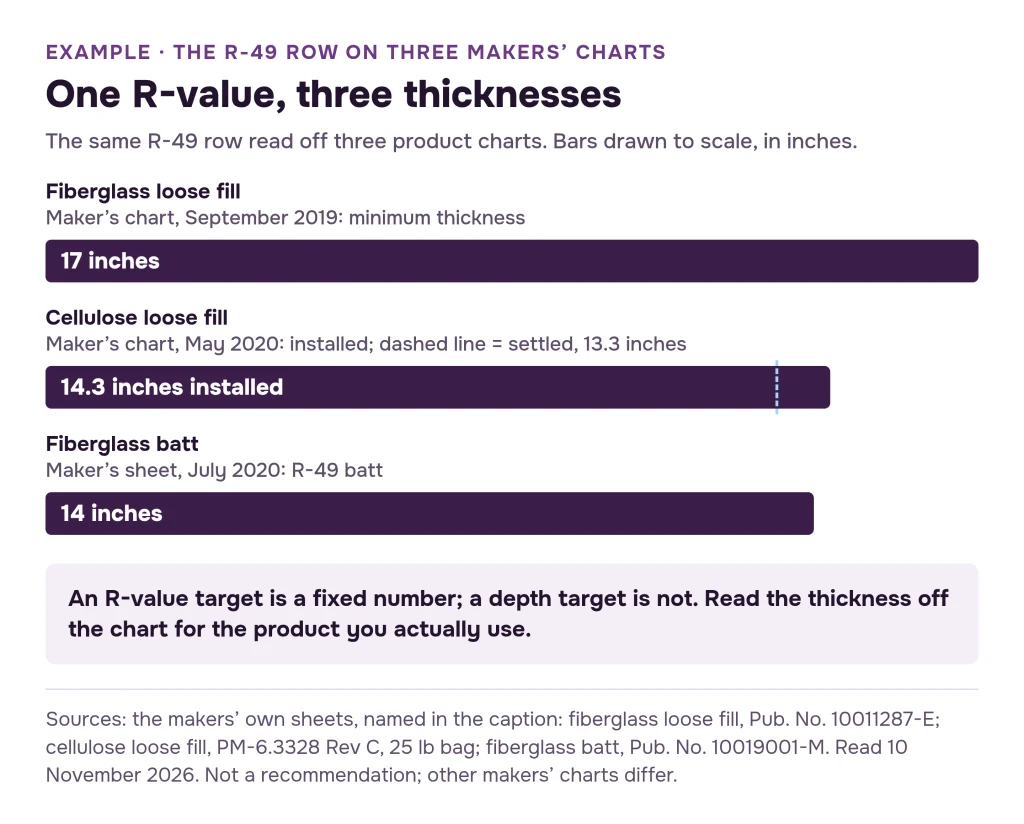
| Fiberglass loose fill at that row | Owens Corning AttiCat chart, minimum thickness | 17 inches |
| Cellulose loose fill at that row | GreenFiber SANCTUARY chart | 14.3 inches installed, 13.3 settled |
| Fiberglass batts at that row | Owens Corning EcoTouch sheet, R-49 batt | 14 inches |
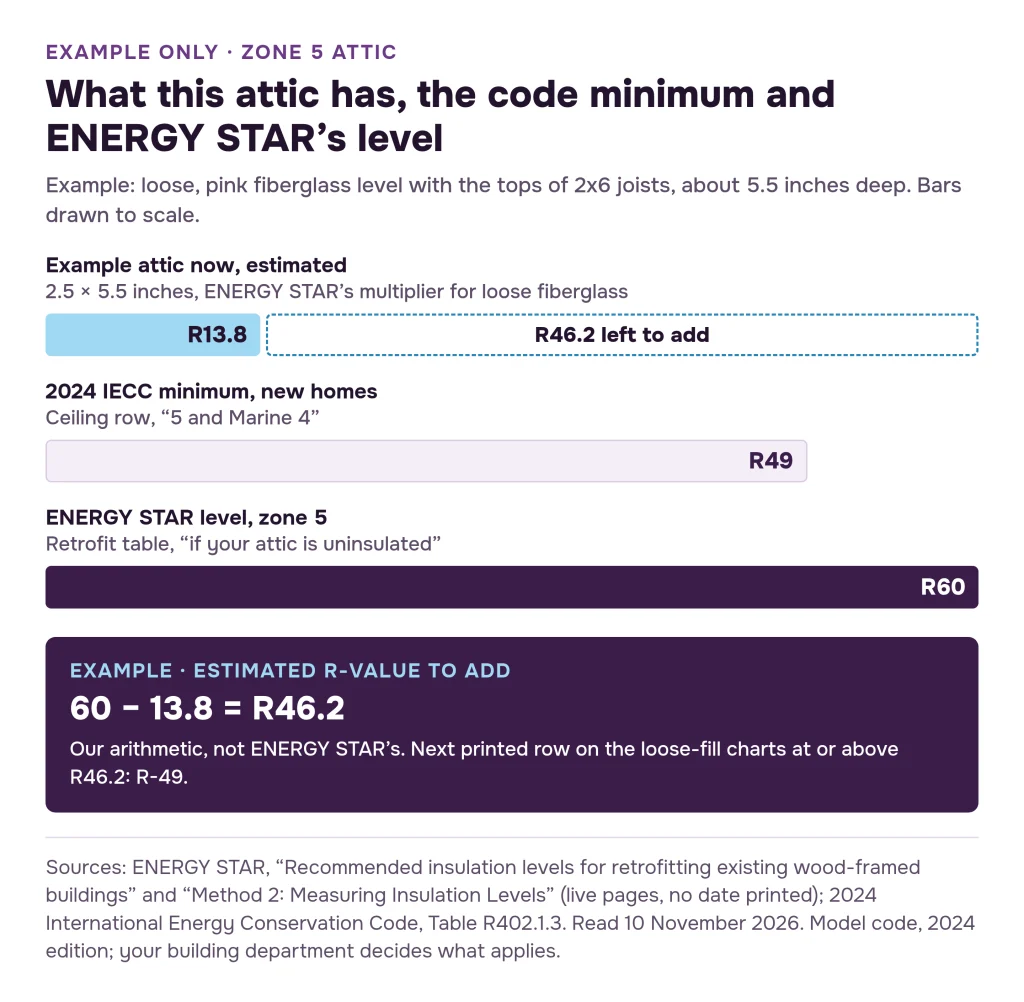
Two things stand out. First, the estimate of what this attic has (about R14) is under a quarter of R60, which is why ENERGY STAR’s quick check says insulation level with the joists probably needs more. Second, the answer in inches depends on the product: 17 inches of one, 14.3 of another. An R-value target is a fixed number; a depth target is not.
The layers add. The 2024 IECC counts insulation installed in layers by summing their R-values, and counts blown-in insulation at the maker’s settled R-value (R402.1.4). So new insulation goes on top of sound, dry existing insulation; it doesn’t have to replace it.
From R-value to inches
Thickness comes from the maker’s chart for the exact product, not from a rule of thumb. For loose fill, the bag chart gives a minimum thickness and a minimum number of bags for each R-value, and both must be met. Owens Corning’s fact sheet puts it this way: failing to provide “both the required number of bags and at least the minimum thickness will result in lower insulation R-value”. These are the rows the calculator reads.
| R-value row | AttiCat fiberglass loose fill: minimum thickness | SANCTUARY cellulose loose fill: installed / settled | EcoTouch fiberglass batt |
|---|---|---|---|
| R-13 | 5 in. | 3.9 / 3.6 in. | 3½ in. |
| R-19 | 7 in. | 5.7 / 5.3 in. | 6¼ in. |
| R-22 | 8 in. | 6.6 / 6.1 in. | 6¾ in. |
| R-26 | 9.5 in. | 7.7 / 7.2 in. | none on the sheet |
| R-30 | 10.75 in. | 8.9 / 8.3 in. | 9½ in. |
| R-38 | 13.5 in. | 11.2 / 10.4 in. | 12 in. |
| R-44 | 15.5 in. | 12.9 / 12.0 in. | none on the sheet |
| R-49 | 17 in. | 14.3 / 13.3 in. | 14 in. |
| R-60 | 20.5 in. | 17.3 / 16.1 in. | none on the sheet |
The calculator rounds up to the next row in the table above instead of interpolating, because a chart row is what the maker stands behind. Your product’s own chart may print a row closer to your number. To turn a row into a bag count for your attic’s area, use the blown-in insulation calculator. For foam board, spray foam and other batts, the R-value to inches tool reads more makers’ sheets.
Depth has to fit. Seventeen inches of loose fill at the eaves can block the soffit vents that let air into the attic, and ENERGY STAR’s guide says never to lay insulation over soffit vents. Keeping that air path open is the job of attic baffles.
Before you add any
More insulation is the last step, not the first. ENERGY STAR’s attic insulation project page says “EPA recommends air sealing the attic before adding attic insulation”. The order of work is on our page about air sealing the attic.
The same page lists conditions where it recommends you “consult or hire a professional to correct these problems before proceeding”. Treat each as a stop:
- Difficult attic access and limited space to work
- Wet or damp insulation, a sign of a leaky roof
- Moldy or rotted rafters or floor joists
- Kitchen, bathroom or clothes dryer vents that blow into the attic instead of outdoors
- Little or no attic ventilation
- Knob and tube wiring (pre-1930), “which can be a fire hazard when in contact with insulation”. That one needs a licensed electrician before any insulation goes near it
ENERGY STAR’s DIY guide adds two more to that list: a history of ice dams in the winter, and many unsealed and uninsulated recessed “can” lights, which it says need special care. It also gives one clearance: “Keep all insulation at least 3 inches away from ‘can’ lights, unless they are rated IC”. ENERGY STAR says to check the fixture for the IC designation first. If you can’t find one, treat the fixture as not rated; more on our page about recessed lights and insulation.
And once a house has been tightened, the guide says to have your heating and cooling technician check that the gas or oil furnace, water heater and dryer are venting properly. Keep working carbon monoxide alarms.
What the calculator can’t tell you
- Whether your job meets code. It compares your attic to a recommendation and shows a model-code minimum for new homes. Whether a permit is needed, which edition applies and what an alteration must meet are your building department’s decisions.
- The real R-value of old insulation. The multipliers are ENERGY STAR’s rough figures for a material identified by eye. Wet, matted or uneven insulation is not what they describe.
- Sloped ceilings, knee walls and finished attics. The attic figures are for insulation on the floor of an open attic. A cathedral ceiling has only the depth of its rafters to work with.
- What it will cost or save. This site doesn’t price jobs. Get written quotes that state the R-value you are buying.
For the whole picture of the attic job, from the first look through the hatch to the last bag, start with our attic insulation guide.
What to do next
- Find your zone in the state and county list, and note whether you are in 4C.
- Look into the attic from the hatch with a flashlight. Granules, wet insulation, mold, knob and tube wiring or a vent blowing into the attic are all stops.
- If none apply, measure the depth in a few places without stirring the insulation, and run the calculator.
- Seal air leaks before adding anything, then have the heating technician check appliance venting.
- Buy or specify by R-value, and read the thickness and bag count off the chart on the product you actually use.
- Ask your building department which energy code edition it enforces and whether adding attic insulation needs a permit.
Sources checked on 10 November 2026.
Formulas and sources
- ENERGY STAR's R-value per inch of depth for what is there now: ENERGY STAR: DIY Checks and Inspections, R-value from measured depth (live page, read 10 Nov 2026)
- Estimated R-value now: multiplier times depth (0 for walls): ENERGY STAR: DIY Checks and Inspections, R-value from measured depth (live page, read 10 Nov 2026)
- ENERGY STAR, 'If your attic is uninsulated', by zone: ENERGY STAR: Recommended Home Insulation R-Values, retrofit table (live page, read 10 Nov 2026)
- ENERGY STAR, 'Floor', by zone: ENERGY STAR: Recommended Home Insulation R-Values, retrofit table (live page, read 10 Nov 2026)
- ENERGY STAR level for the place chosen (0 for walls): ENERGY STAR: Recommended Home Insulation R-Values, retrofit table (live page, read 10 Nov 2026)
- ENERGY STAR, 'If you already have 3-4 inches of insulation', attic only: ENERGY STAR: Recommended Home Insulation R-Values, retrofit table (live page, read 10 Nov 2026)
- R-value to add: ENERGY STAR level minus the estimate of what is there, never below 0: Our arithmetic on the reader's entries, no outside figure
- 2024 IECC Table R402.1.3, ceiling or floor (cavity option) R-value, new homes: 2024 IECC Table R402.1.3, model code minimums for new homes (read 10 Nov 2026)
- Wall zone group: 0 not a wall, 1 zones 1 and 2, 2 zone 3, 3 zones 4 to 8: Our arithmetic on the reader's entries, no outside figure
- Loose-fill chart row: the next R-value at or above the amount to add (attic only): Our arithmetic on the reader's entries, no outside figure
- AttiCat chart: minimum thickness at that row, inches: Owens Corning AttiCat fact sheet, Pub. No. 10011287-E, September 2019 (read 10 Nov 2026)
- GreenFiber chart: initial installed thickness at that row, inches: GreenFiber SANCTUARY attic coverage chart, 25 lb bag, PM-6.3328 Rev C, May 2020, retailer-hosted copy of the maker's sheet (read 10 Nov 2026)
- GreenFiber chart: settled thickness at that row, inches: GreenFiber SANCTUARY attic coverage chart, 25 lb bag, PM-6.3328 Rev C, May 2020, retailer-hosted copy of the maker's sheet (read 10 Nov 2026)
- Next R-13, 19, 22, 30, 38 or 49 batt on the EcoTouch sheet at or above the amount to add (0 if none or a wall): Owens Corning EcoTouch submittal sheet, Pub. No. 10019001-M, July 2020, retailer-hosted copy of the maker's sheet (read 10 Nov 2026)
- EcoTouch sheet: thickness of that batt, inches: Owens Corning EcoTouch submittal sheet, Pub. No. 10019001-M, July 2020, retailer-hosted copy of the maker's sheet (read 10 Nov 2026)
Sources
- ENERGY STAR: Recommended Home Insulation R-Values, retrofit table for existing wood-framed buildings (live page, no date; read 10 Nov 2026)
- ENERGY STAR: What to Look For: DIY Checks and Inspections, depth-to-R-value multipliers and an older table of ranges (live page, no date; read 10 Nov 2026)
- 2024 International Energy Conservation Code, Table R402.1.3 and Sections R402.1.4 and R402.2.1 (model code, read in a browser 10 Nov 2026)
- 2021 International Energy Conservation Code, Table R402.1.3, ceiling and floor rows (model code, read in a browser 10 Nov 2026)
- PNNL-33270: Guide to Determining Climate Zone by County, Building America and IECC 2021 Updates (September 2022; OSTI record, PDF read 10 Nov 2026)
- PNNL Building America Solution Center: climate zone lookup (linked as a lookup only; no result relied on)
- ENERGY STAR: A Do-It-Yourself Guide to Sealing and Insulating, EPA 430-F-04-024 (2016 text, file modified 7 Jun 2024; read 10 Nov 2026)
- ENERGY STAR: Attic Insulation Project (live page, no date; read 10 Nov 2026)
- DOE Energy Saver: Insulation (live page returns 404; Internet Archive capture of 22 Jun 2026, read 10 Nov 2026)
- EPA: Protect Your Family from Asbestos-Contaminated Vermiculite Insulation (last updated 17 Apr 2026; read 10 Nov 2026)
- Owens Corning: AttiCat Expanding Blown-In Insulation fact sheet, Pub. No. 10011287-E, September 2019 (maker's sheet, read 10 Nov 2026)
- GreenFiber: SANCTUARY attic coverage chart, 25 lb bag, PM-6.3328 Rev C, May 2020; the maker's own sheet in a retailer-hosted copy (read 10 Nov 2026)
- Owens Corning: EcoTouch PINK Fiberglas Insulation submittal sheet, Pub. No. 10019001-M, July 2020; the maker's own sheet in a retailer-hosted copy (read 10 Nov 2026)