To work out bags of blown-in insulation, take the “bags per 1,000 sq ft” figure from the coverage chart of the exact product you are buying, at the R-value you want, multiply it by your attic floor area and divide by 1,000. Round up. Then blow it to at least the minimum thickness on the same row of the chart. Both numbers have to be met, and both depend on the product: for R-49 over 1,000 square feet, the Owens Corning AttiCat chart prints 25 bags at 17 inches, and the Greenfiber SANCTUARY cellulose chart prints 72.6 bags at 14.3 inches. The calculator on this page, part of our attic guides, does that sum from five charts we have read in the makers’ own sheets (three makers, five products), and takes off what your existing insulation is already worth.
General information, not professional advice. Building codes are adopted locally, with changes, and your building department decides what applies to your house. Stop and call a qualified professional for anything this page marks as a stop.
This page covers loose fill, the loose fibers blown from a machine, on an open attic floor. It does not cover walls, sloped ceilings or dense-packed cavities, which use different charts. The result is an estimate: the chart printed on your own bag wins wherever it differs. The Insulation Book sells nothing and never prices a job. Product names appear here because each chart belongs to one product, not as a pick or a ranking.
What to enter
- Product. Pick the product named on the bag. The list holds only the five products whose attic chart we read in the maker’s own sheet (the tables below). Three are contractor products, so you are more likely to meet them on an installer’s quote than on a store shelf.
- Attic floor area. Measure the length and width of the attic floor, or of the rooms below it, and multiply. Split an L-shaped attic into rectangles and add them. Leave out any part you won’t insulate.
- Total R-value you want. R-value measures resistance to heat flow; higher insulates more. ENERGY STAR’s retrofit table (read 10 November 2026) gives R30 for an uninsulated attic in climate zone 1 (the warmest of the eight zones the energy code divides the country into), R49 in zones 2 and 3, and R60 in zones 4 to 8. If you don’t know your zone or your target, start with the how much insulation do I need calculator.
- What is already there, and how deep. Choose the material and enter its average depth, measured with a ruler in several places. Enter 0 for a bare attic floor.
For the existing layer, the calculator uses ENERGY STAR’s rough multipliers from its DIY checks and inspections page (read 10 November 2026). They are ENERGY STAR’s estimates for old insulation in place. They are not a rating for anything new: for new loose fill, only the chart counts. The same page also prints a table of R-value ranges (R30 to R60 for an uninsulated attic in zones 2 and 3, for example); the figures in step 3 are from ENERGY STAR’s retrofit table, which gives one figure per zone.
| What you see (ENERGY STAR’s descriptions) | What it probably is | Estimated R-value |
|---|---|---|
| Loose fibers, light-weight, yellow, pink or white | Loose fiberglass | 2.5 x depth in inches |
| Loose fibers, dense gray or near white, may have black specks | Rock wool | 2.8 x depth |
| Loose fibers, small gray flat pieces or fibers (from newsprint) | Cellulose | 3.7 x depth |
| Batts, light-weight, yellow, pink or white | Fiberglass batts | 3.2 x depth |
| Light-weight granules | Vermiculite or perlite | Stop: see the vermiculite section |
How to read the results
- R-value to add. The total you picked minus the estimate for what you have. This is our arithmetic, on the rule that the R-values of layers add up (DOE, “Insulation”, archived 22 June 2026; the live page was removed).
- Chart row to blow. The calculator works with the nine R-value rows that all five charts print (R-13, R-19, R-22, R-26, R-30, R-38, R-44, R-49 and R-60) and uses the first of those at or above the R-value to add. If you need to add R-45.2, it uses the R-49 row. If you need less than R-13, it uses R-13, the lowest of the nine. Some charts print rows in between (the Owens Corning Professional Loosefill chart prints every R-value from 13 to 60, and the Greenfiber chart adds R-32, R-40, R-48 and R-50; the Greenfiber chart and the Climate Pro B7600 card also print an R-11 row below the nine). If your bag’s chart has a row closer to what you need, you can use that row’s bags and thickness; the calculator’s answer is then on the high side.
- Bags per 1,000 sq ft and bags for your area. The first is the chart’s own figure. The second is that figure times your area, divided by 1,000 and rounded up to whole bags. It includes no spare bag.
- Minimum initial installed thickness. How deep the new layer must be, at the least, when you finish blowing.
- Minimum settled thickness. How deep the new layer must still be after long-term settling. The four fiberglass charts print the same figure for both. The cellulose chart prints a lower settled figure.
- Ruler mark. Your existing depth plus the new layer’s installed minimum: the height above the ceiling drywall to blow to. Treat it as a guide. An old loose layer may pack down under new weight (our caution, not a sourced figure), which is one more reason the bag count has to be met as well.
- Total R-value after the job. The existing estimate plus the chart row, as an estimate.
Why step up to a row a chart prints and not work out something in between? Because loose fill does not scale in a straight line. DOE’s archived page puts it this way: as installed thickness increases, the settled density increases “due to compression of the insulation under its own weight”, so “loose-fill insulation R-value does not change proportionately with thickness”. The charts show it. On the Owens Corning Professional Loosefill chart, R-30 takes 10.5 inches and 12.4 bags per 1,000 square feet. R-60 takes 19.75 inches, less than double the depth, and 27.1 bags, more than double the bags. The FTC’s R-value Rule also bars makers from giving an “R-value per inch” on labels, fact sheets and ads unless test results prove it does not drop as the product gets thicker (16 CFR 460.20). So a single “inches times R per inch” sum is the wrong tool for new loose fill. For batts, boards and other materials, our insulation thickness lookup gives the depth each maker’s sheet prints.
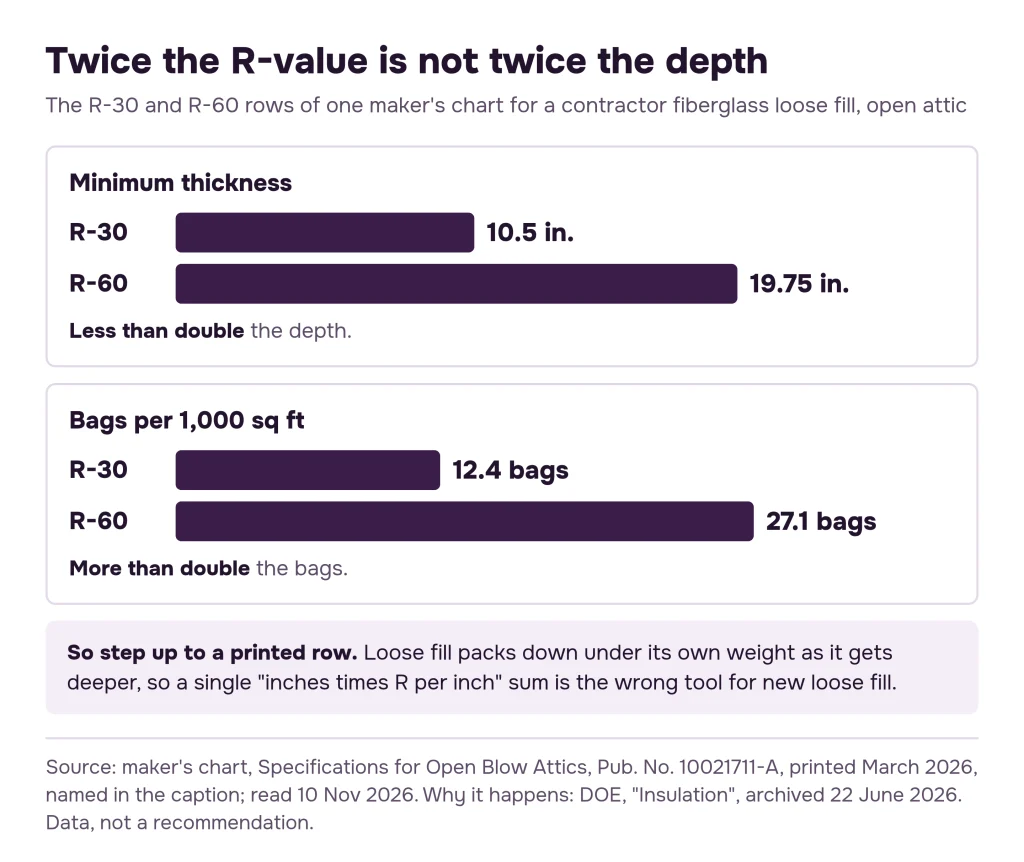
Bags and thickness: both must be met
The chart exists because a federal rule requires it. Under the FTC’s R-value Rule, 16 CFR 460.12(b)(2) (eCFR, up to date as of 6 November 2026), every package of loose-fill insulation must carry a chart showing, at R-13, R-19, R-22, R-30, R-38 and R-49 and any other R-value the maker lists:
- the minimum settled thickness,
- the initial installed thickness,
- the maximum net coverage area,
- the number of bags per 1,000 square feet, and
- the minimum weight per square foot.
The label must also state the minimum net weight in the package and say which blowing machine and settings were used to get the installed thickness.
The makers say plainly that one number is not enough. Owens Corning’s AttiCat sheet says the stated R-value comes from installing the required number of bags at no less than the label’s minimum thickness, and that an installer who fails to provide both ends up with a lower R-value. Greenfiber’s sheet says the applicator must install both the minimum bags per 1,000 sq ft and the minimum installed thickness, and must not go over the maximum coverage per bag.
The reason is in the chart’s weight column. A stated R-value needs a minimum weight of material on every square foot. Depth alone doesn’t prove the weight is there, because the same bag can be blown lighter and deeper. Bag count alone doesn’t prove it either, if the material is piled in the middle and thin at the eaves. So count the empty bags, and check the depth across the whole floor.
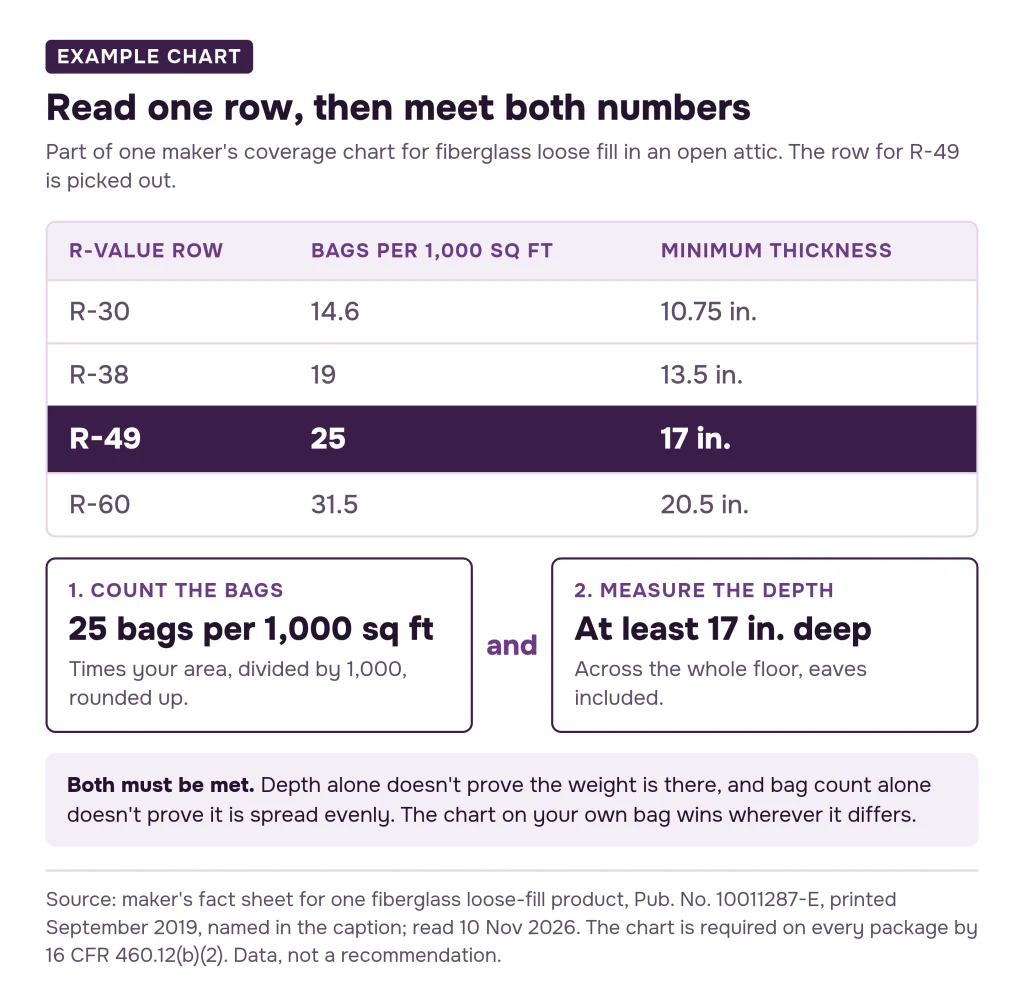
The five charts we read
These are the figures the calculator uses, copied from each maker’s sheet and re-read on 10 November 2026. They are the nine rows all five charts share; some charts print more rows than these. Bags are per 1,000 square feet of net area, meaning the floor actually covered.
| R-value row | Owens Corning AttiCat | Greenfiber SANCTUARY | Owens Corning Professional Loosefill | Johns Manville Climate Pro B7600 | Johns Manville Climate Pro A1000 |
|---|---|---|---|---|---|
| R-13 | 5.9 | 15.2 | 5.1 | 5.7 | 5.5 |
| R-19 | 9 | 22.6 | 7.8 | 8.4 | 8.1 |
| R-22 | 10.5 | 26.3 | 9.0 | 9.8 | 9.4 |
| R-26 | 12.6 | 32.1 | 10.7 | 11.7 | 11.2 |
| R-30 | 14.6 | 38.6 | 12.4 | 13.7 | 13.0 |
| R-38 | 19 | 52.6 | 16.4 | 17.7 | 16.8 |
| R-44 | 22.4 | 63.5 | 19.1 | 20.8 | 20.1 |
| R-49 | 25 | 72.6 | 21.5 | 23.4 | 22.6 |
| R-60 | 31.5 | 92.5 | 27.1 | 29.2 | 28.5 |
| R-value row | Owens Corning AttiCat | Greenfiber SANCTUARY (installed / settled) | Owens Corning Professional Loosefill | Johns Manville Climate Pro B7600 | Johns Manville Climate Pro A1000 |
|---|---|---|---|---|---|
| R-13 | 5 | 3.9 / 3.6 | 4.75 | 4.9 | 4.75 |
| R-19 | 7 | 5.7 / 5.3 | 7.00 | 7.0 | 6.75 |
| R-22 | 8 | 6.6 / 6.1 | 8.00 | 8.1 | 7.75 |
| R-26 | 9.5 | 7.7 / 7.2 | 9.25 | 9.4 | 9.00 |
| R-30 | 10.75 | 8.9 / 8.3 | 10.50 | 10.8 | 10.25 |
| R-38 | 13.5 | 11.2 / 10.4 | 13.25 | 13.4 | 12.75 |
| R-44 | 15.5 | 12.9 / 12.0 | 15.00 | 15.3 | 14.75 |
| R-49 | 17 | 14.3 / 13.3 | 16.50 | 16.9 | 16.25 |
| R-60 | 20.5 | 17.3 / 16.1 | 19.75 | 20.2 | 19.50 |
The sheets themselves: AttiCat, Greenfiber SANCTUARY, Owens Corning Professional Loosefill, Climate Pro B7600 and Climate Pro A1000. Five things to know before you compare columns:
- A bag is not a standard size. The AttiCat sheet gives a nominal bag weight of 27.5 lb. The Greenfiber sheet gives 25 lb nominal and 23.75 lb minimum net. The Owens Corning professional sheet and the two Johns Manville cards print no bag weight, so we state none. More bags does not mean more money or a worse product; it means a different bag of a different material. This table cannot rank anything.
- Each chart belongs to a machine. Owens Corning’s professional chart was set with a ProCat machine, 100 feet of 2.5-inch hose and the maker’s preset attic settings. Greenfiber’s was set with a Volumatic III in 3rd gear with an 8-inch gate. The Climate Pro A1000 card names a Unisul Volu-Matic III in 3rd gear with a 75% open gate and a 3-inch hose. Use the machine and settings your bag names.
- Framing. Greenfiber prints a second set of columns adjusted for 2×6 joists at 16-inch centers (70.2 bags per 1,000 sq ft at R-49, not 72.6). The calculator uses the unadjusted figures, which ask for slightly more. The A1000 card says its coverage is “without framing”.
- Sheet dates. The A1000 card is dated March 2014, the B7600 card June 2018, the AttiCat sheet September 2019, the Greenfiber sheet May 2020 and the Owens Corning professional sheet March 2026. A bag made this year carries its own chart. Read it.
- Minnesota. The AttiCat sheet and both Johns Manville cards print extra inches and bags for Minnesota, where, the cards say, state law requires insulation to give its stated R-value at winter design temperatures. On the AttiCat sheet that adds 2.0 inches and 3.7 bags per 1,000 sq ft at R-49. The calculator does not add these: Minnesota readers should use the extra Minnesota figures printed on the sheet or card.
Other products, including store brands, are not in the list because we have not read their charts in the maker’s own document. The method is the same for any of them: find your R-value row on the bag, take the bags per 1,000 sq ft, multiply by your area over 1,000, round up, and blow to the minimum thickness.
Worked example
General information, not professional advice. Building codes are adopted locally, with changes, and your building department decides what applies to your house. Stop and call a qualified professional for anything this page marks as a stop.
The calculator opens on the simplest case: Owens Corning AttiCat, 1,000 sq ft, R-49 wanted, nothing on the attic floor. Nothing is taken off, so the R-value to add is 49 and the chart row is R-49. That row prints 25 bags per 1,000 sq ft and 17 inches, so the answer is 25 bags, a new layer at least 17 inches deep, a ruler mark of 17 inches and an estimated total of R-49.
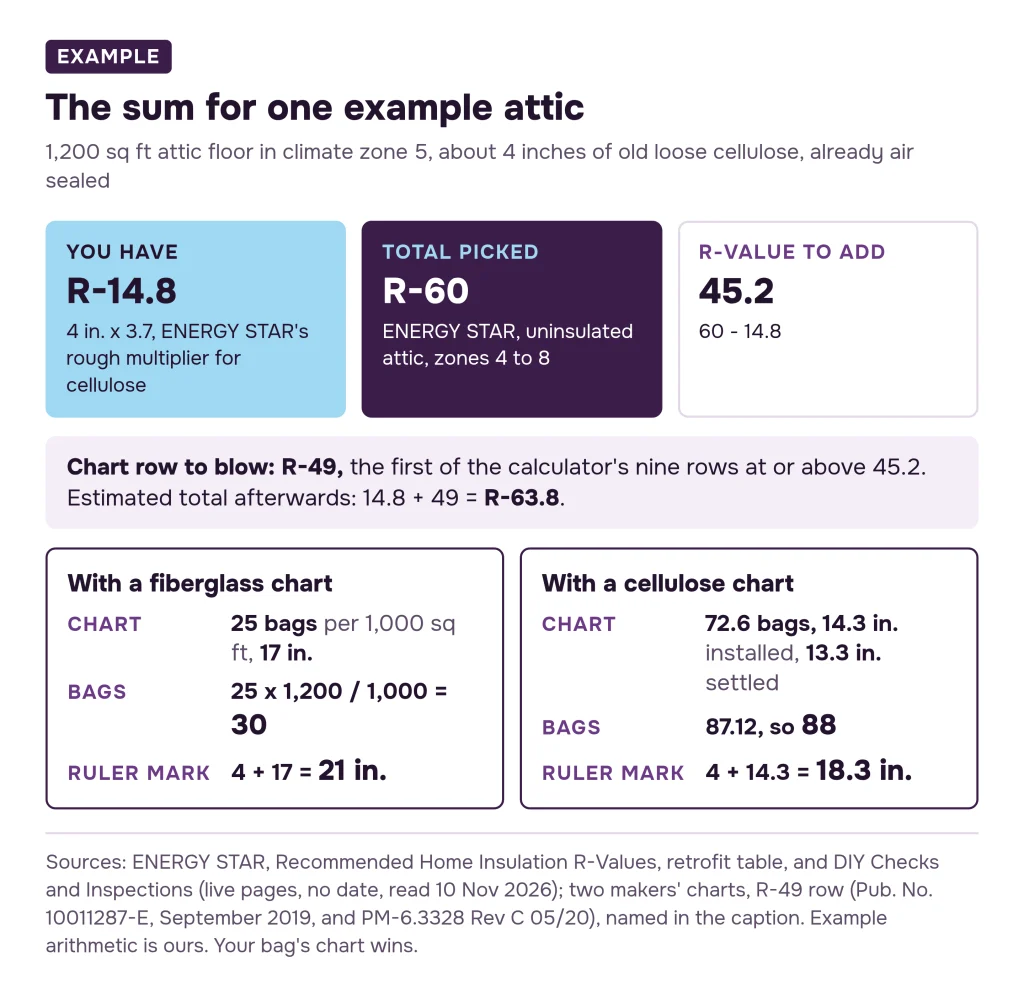
A fuller example, with insulation already in place: a 1,200 sq ft attic floor in climate zone 5, with about 4 inches of old loose cellulose, already air sealed. The owner picks R-60, ENERGY STAR’s figure for an uninsulated attic in that zone.
- Existing estimate: 4 inches x 3.7 = R-14.8 (ENERGY STAR’s multiplier for cellulose).
- R-value to add: 60 – 14.8 = 45.2.
- Chart row: of the nine rows the calculator uses, the first at or above 45.2 is R-49.
- With AttiCat: the R-49 row prints 25 bags per 1,000 sq ft and 17 inches. 25 x 1,200 / 1,000 = 30 bags. New layer at least 17 inches deep, so the ruler mark is about 4 + 17 = 21 inches above the ceiling.
- With Greenfiber SANCTUARY instead: the R-49 row prints 72.6 bags, 14.3 inches installed and 13.3 inches settled. 72.6 x 1,200 / 1,000 = 87.12, so 88 bags. Ruler mark about 4 + 14.3 = 18.3 inches. (This chart also prints an R-48 row, 70.8 bags and 14.0 inches installed, which covers 45.2 as well; the calculator keeps to the nine rows all five charts share.)
- Estimated total: 14.8 + 49 = R-63.8 either way.
ENERGY STAR’s table also has a column headed “If you already have 3–4 inches of insulation”, which prints R49 for zone 5. ENERGY STAR does not say whether that figure is a total or an amount to add, so the calculator works from the first column and shows its subtraction.
Before you buy bags
ENERGY STAR calls attic insulation a moderately difficult do-it-yourself job, and says of loose fill that “it may be wise to hire a professional, as the application requires the use of a blowing machine, although some home improvement stores offer rentals of this machine” (Attic Insulation Project, read 10 November 2026). That page and ENERGY STAR’s DIY guide (EPA 430-F-04-024, 2016) list conditions where ENERGY STAR recommends consulting or hiring a professional to correct the problem first. Look for them before you buy a single bag:
- wet or damp insulation, which points to a roof leak;
- moldy or rotted rafters or floor joists;
- kitchen, bathroom or dryer vents that blow into the attic and not outdoors;
- a history of ice dams;
- little or no attic ventilation;
- knob-and-tube wiring (pre-1930), which ENERGY STAR says can be a fire hazard in contact with insulation: that is a job for a licensed electrician, covered in knob-and-tube wiring and insulation;
- many unsealed and uninsulated recessed “can” lights, which the guide says need special care when you insulate around them;
- difficult access and little room to work.
Then, in order:
- Seal first. “EPA recommends air sealing the attic before adding attic insulation” (ENERGY STAR). Once the new layer is down, the leaks are buried. See air sealing the attic. ENERGY STAR’s DIY guide adds that after work that tightens the house, you should have a heating and cooling technician check that gas or oil appliances (furnace, water heater, dryer) are venting properly. Keep working carbon monoxide alarms in the house as well.
- Keep insulation off hot things. ENERGY STAR: keep all insulation at least 3 inches away from recessed “can” lights unless they are rated IC (insulation contact), and with loose fill use sheet metal or wire mesh to make a barrier. Every bag of cellulose must carry the federal caution to keep it “at least three inches away from the sides of recessed light fixtures”, not to place it over them, and to keep it away from exhaust flues (16 CFR 1404.4). For flues, ENERGY STAR’s DIY guide says “building codes usually require 1 inch of clearance from metal flues (2 inches from masonry chimneys)” to anything combustible, insulation included, with a metal dam to hold it back. The vent’s own listing and your building department govern.
- Keep the eave vents open. ENERGY STAR: never cover soffit vents (the intake vents under the eaves) with insulation. Rafter vents, also called attic baffles, hold a channel open, and blown insulation may need a block at the outer edge of the wall’s top plate so it doesn’t spill into the soffit.
- Protect yourself, and blow it level. Walk on joists or truss chords, never on the drywall between them. ENERGY STAR’s guide calls for an OSHA-approved particulate respirator or double-strap dust mask, safety glasses and gloves. It also asks for insulation spread evenly with no low spots: sometimes there is enough in the middle of the attic and very little along the eaves.
The full sequence, as far as ENERGY STAR and the bag label give it, is in how to blow in attic insulation yourself.
Stop: granules that could be vermiculite
If the attic floor holds a pebble-like, pour-in material that is “usually gray-brown or silver-gold in color” (EPA’s description), do not measure it, rake it, walk through it or blow new insulation over it. EPA’s instruction is direct: “You should assume the vermiculite contains asbestos and do not disturb it.” EPA also says not to store boxes in that attic, not to let children play there, not to try to remove the insulation yourself, and to hire a professional asbestos contractor before any work that would disturb it (EPA, read 10 November 2026). EPA adds that testing is not needed to take these precautions.
ENERGY STAR’s attic pages say not to disturb vermiculite “unless you have had it tested”. This site follows EPA’s asbestos page, which is the stricter of the two. That is why choosing “granules” in the calculator returns a stop and no numbers. More in vermiculite insulation: what to do.
If you hire: check the receipt against the chart
The same federal rule gives you a way to check a contractor’s work. Under 16 CFR 460.17, an installer must give you a contract or receipt, dated and signed by the installer. For loose fill it must show:
- the coverage area,
- the initial installed thickness,
- the minimum settled thickness,
- the R-value, and
- the number of bags used.
Check those five numbers against the product’s chart: find the R-value on the receipt and multiply the chart’s bags per 1,000 sq ft by the area on the receipt. If the receipt shows fewer bags than the chart asks for, or the depth in your attic is under the chart’s minimum, ask the installer to explain the difference in writing. Ask for the product name and its fact sheet before the job: under 16 CFR 460.13, makers must give installers and retailers a fact sheet carrying the chart, and under 460.14 a store selling to do-it-yourself customers must make the fact sheets available to them, unless the packages on display carry the same information. The receipt and what else to ask are covered in our guide to blown-in insulation, DIY or hired.
What this calculator does not do
- It doesn’t replace the bag. Makers reissue charts. If the chart on your bag differs from the sheet named here, the bag is right.
- It doesn’t say what your building department requires. ENERGY STAR’s figures are recommendations it calls cost-effective, not a code.
- It doesn’t rate the old layer precisely. The existing R-value is ENERGY STAR’s depth estimate. Old insulation that is damp, matted or patchy is worth less, and damp insulation is on the stop list above.
- It doesn’t subtract joists or add spare bags. It multiplies the chart figure by the area you enter.
You may see a single “square feet per bag” figure for blown-in insulation on other sites. We checked that idea against the charts, and no single figure fits. At R-49, one bag covers at most 39.9 sq ft on the AttiCat chart, 46.4 on the Owens Corning professional chart, 43 on the Climate Pro B7600 card, 44.2 on the A1000 card and 13.8 on the Greenfiber SANCTUARY chart. At R-30 the same AttiCat bag covers up to 68.5 sq ft. Coverage depends on the product and on the R-value.
Your next step
- Look across the attic from the hatch before you step in. Granules: stop. Anything on ENERGY STAR’s list above: get that fixed first.
- Measure the floor area and the depth of what is there, in several places.
- Run the calculator for the product you can actually buy or the one on your installer’s quote.
- At the store, read the chart on the bag and redo the sum if its numbers differ.
- Seal the attic floor’s air leaks before any bag is opened.
- Afterwards, count the empty bags and check the depth with a ruler in several places, eaves included. If you hired the job, compare the signed receipt with the chart.
Sources checked on 10 November 2026.
Formulas and sources
- Estimated R-value of the existing insulation: ENERGY STAR: What to Look For, DIY Checks and Inspections (depth multipliers for existing attic insulation)
- R-value to add: total wanted minus existing estimate: DOE Energy Saver: Insulation (add the R-values of the individual layers), archived 22 Jun 2026; live page removed
- Chart row used: first of the nine rows all five charts share, at or above the R-value to add: 16 CFR 460.12(b)(2): loose-fill label chart (eCFR, up to date 6 Nov 2026)
- Bags per 1,000 sq ft, AttiCat chart: Owens Corning AttiCat Expanding Blown-In Insulation fact sheet, Pub. No. 10011287-E, printed September 2019
- Bags per 1,000 sq ft, Greenfiber SANCTUARY chart: Greenfiber SANCTUARY cellulose fact sheet, PM-6.3328 Rev C 05/20, attic chart without framing adjustment (retailer-hosted copy of the maker's sheet)
- Bags per 1,000 sq ft, Owens Corning Professional Loosefill chart: Owens Corning Professional Loosefill Insulation, Specifications for Open Blow Attics, Pub. No. 10021711-A, printed March 2026
- Bags per 1,000 sq ft, Climate Pro B7600 chart: Johns Manville Climate Pro B7600 attic coverage card, BIC-260 6/18
- Bags per 1,000 sq ft, Climate Pro A1000 chart: Johns Manville Climate Pro A1000 attic card, BIC-256 03/14
- Bags per 1,000 sq ft of net area on the chart row: 16 CFR 460.12(b)(2): loose-fill label chart (eCFR, up to date 6 Nov 2026)
- Minimum initial installed thickness, AttiCat chart: Owens Corning AttiCat Expanding Blown-In Insulation fact sheet, Pub. No. 10011287-E, printed September 2019
- Minimum initial installed thickness, Greenfiber SANCTUARY chart: Greenfiber SANCTUARY cellulose fact sheet, PM-6.3328 Rev C 05/20, attic chart without framing adjustment (retailer-hosted copy of the maker's sheet)
- Minimum initial installed thickness, Owens Corning Professional Loosefill chart: Owens Corning Professional Loosefill Insulation, Specifications for Open Blow Attics, Pub. No. 10021711-A, printed March 2026
- Minimum initial installed thickness, Climate Pro B7600 chart: Johns Manville Climate Pro B7600 attic coverage card, BIC-260 6/18
- Minimum initial installed thickness, Climate Pro A1000 chart: Johns Manville Climate Pro A1000 attic card, BIC-256 03/14
- Minimum initial installed thickness of the new layer: 16 CFR 460.12(b)(2): loose-fill label chart (eCFR, up to date 6 Nov 2026)
- Minimum settled thickness, Greenfiber SANCTUARY chart: Greenfiber SANCTUARY cellulose fact sheet, PM-6.3328 Rev C 05/20, attic chart without framing adjustment (retailer-hosted copy of the maker's sheet)
- Minimum settled thickness of the new layer (the four fiberglass charts print it equal to installed): 16 CFR 460.12(b)(2): loose-fill label chart (eCFR, up to date 6 Nov 2026)
- Chart bags times your area over 1,000: Arithmetic on the reader's entries, no outside figure
- Whole bags, rounded up: Arithmetic on the reader's entries, no outside figure
- Existing estimate plus the chart row: DOE Energy Saver: Insulation (add the R-values of the individual layers), archived 22 Jun 2026; live page removed
- Existing depth plus the new layer's installed minimum: Arithmetic on the reader's entries, no outside figure
- R per inch of depth, existing loose fiberglass (ENERGY STAR estimate) (2.5, as of 2026-11-10): ENERGY STAR: What to Look For, DIY Checks and Inspections (depth multipliers for existing attic insulation)
- R per inch of depth, existing loose rock wool (ENERGY STAR estimate) (2.8, as of 2026-11-10): ENERGY STAR: What to Look For, DIY Checks and Inspections (depth multipliers for existing attic insulation)
- R per inch of depth, existing loose cellulose (ENERGY STAR estimate) (3.7, as of 2026-11-10): ENERGY STAR: What to Look For, DIY Checks and Inspections (depth multipliers for existing attic insulation)
- R per inch of depth, existing fiberglass batts (ENERGY STAR estimate) (3.2, as of 2026-11-10): ENERGY STAR: What to Look For, DIY Checks and Inspections (depth multipliers for existing attic insulation)
Sources
- 16 CFR 460.12: Labels, loose-fill chart in (b)(2) (eCFR, up to date as of 6 Nov 2026; read 10 Nov 2026)
- 16 CFR 460.13 and 460.14: Fact sheets; how retailers must handle labels and fact sheets (eCFR, read 10 Nov 2026)
- 16 CFR 460.17: What installers must tell their customers (eCFR, read 10 Nov 2026)
- 16 CFR 460.20: R-value per inch claims (eCFR, read 10 Nov 2026)
- 16 CFR 1404.4: Cellulose insulation caution label (eCFR, read 10 Nov 2026)
- Owens Corning: AttiCat Expanding Blown-In Insulation fact sheet, Pub. No. 10011287-E, printed September 2019 (read 10 Nov 2026)
- Greenfiber: SANCTUARY blow-in or spray-applied cellulose insulation fact sheet, PM-6.3328 Rev C 05/20; the maker's own sheet in a retailer-hosted copy (read 10 Nov 2026)
- Owens Corning: Professional Loosefill Insulation, Specifications for Open Blow Attics, Pub. No. 10021711-A, printed March 2026 (read 10 Nov 2026)
- Johns Manville: Climate Pro B7600 fiberglass blowing wool attic coverage card, BIC-260 6/18 (read 10 Nov 2026)
- Johns Manville: Climate Pro A1000 fiber glass blowing wool attic card, BIC-256 03/14 (read 10 Nov 2026)
- ENERGY STAR: Recommended Home Insulation R-Values, retrofit table (live page, no date; read 10 Nov 2026)
- ENERGY STAR: What to Look For, DIY Checks and Inspections (live page, no date; read 10 Nov 2026)
- ENERGY STAR: Attic Insulation Project (live page, no date; read 10 Nov 2026)
- ENERGY STAR: A Do-It-Yourself Guide to Sealing and Insulating, EPA 430-F-04-024 (2016 text; read 10 Nov 2026)
- DOE Energy Saver: Insulation (live page removed; Internet Archive capture of 22 Jun 2026, read 10 Nov 2026)
- EPA: Protect Your Family from Asbestos-Contaminated Vermiculite Insulation (read 10 Nov 2026)